
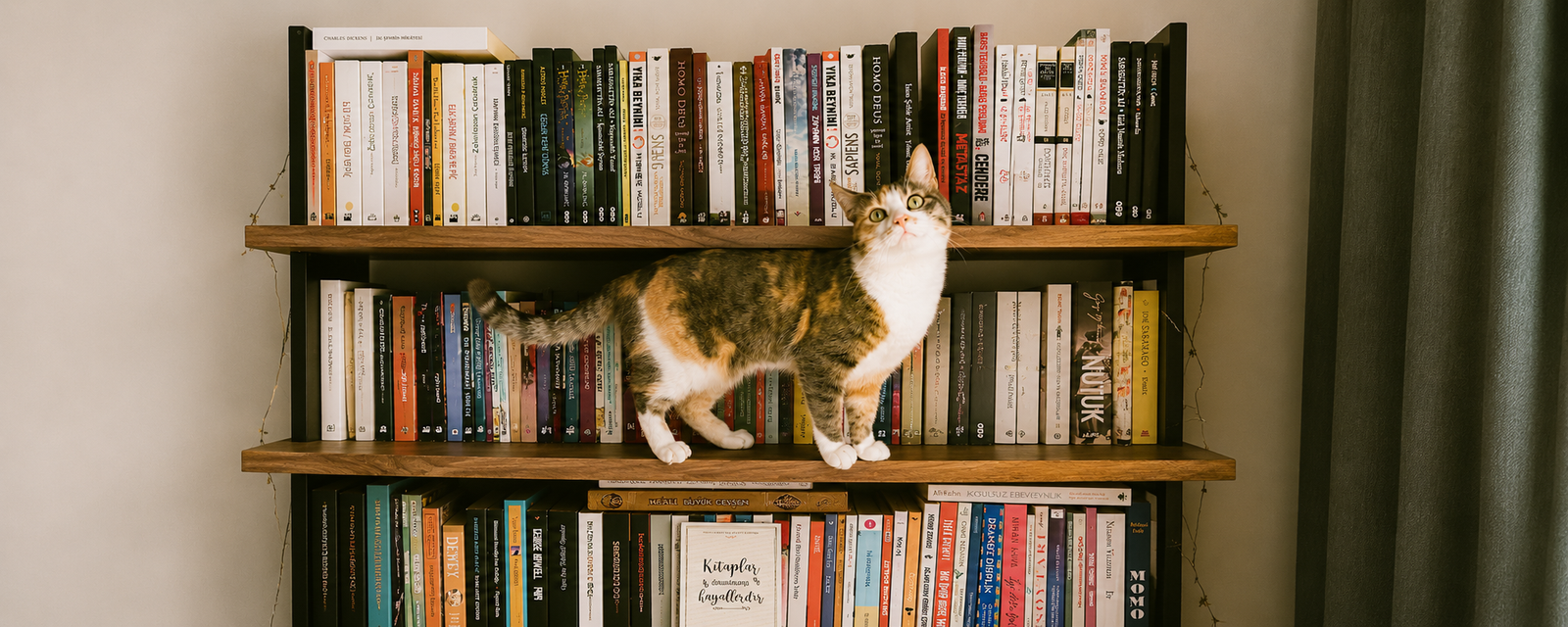
A friend of mine rearranges her bookshelf every few months, and every time I visit, I can tell exactly what she’s been going through. Heartbreak era: poetry moved to eye level, everything else shoved to the bottom. New job era: business books suddenly visible from the couch. She swears she doesn’t do it on purpose. I believe her—mostly—which is what makes bookshelves so interesting. We don’t always control what they say about us.

The Science of It
Psychologist Sam Gosling spent years sending research teams into strangers’ bedrooms and offices (yeah, sounds a bit too intrusive) , then comparing what one could guess about the occupant’s personality against what the occupant’s own friends said about them. His book Snoop: What Your Stuff Says About You found that our spaces often reveal more than conversation does. Bedrooms, he found, tend to expose openness to experience, conscientiousness, and neuroticism, while offices reveal openness and extraversion. Read the interview here. None of his research zoomed in on shelves specifically, but the logic scales down neatly. A bookshelf sits somewhere between a bedroom and an office, half private confession and half public display, visible to guests yet arranged mostly for yourself, which is exactly why it’s such a rich thing to study. It’s also one of the few personal artefacts people rarely stage for visitors the way they might tidy a coffee table. Most of us shelve books for our own convenience first and worry about how it looks second, which means the resulting system tends to be more honest than we intend it to be.
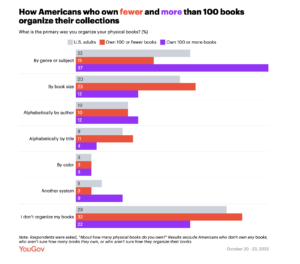
That instinct shows up in the data too. A YouGov survey of nearly 29,400 American adults found that 29 percent of book owners don’t organize their shelves at all, more than any single deliberate system. Of the ones who do bother, 22 percent sort by subject, 20 percent by size, 10 percent alphabetically by author, 9 percent alphabetically by title, and only 3 percent by colour, despite how often colour-coded shelves show up online. So the aesthetic, Instagram-ready bookshelf is rarer in real life than the algorithm makes it look, which says something on its own about the gap between how we display our reading lives and how we actually live them.
The Art of It
Courtesy: The Marginalia
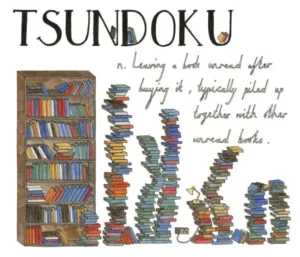
Then there’s the part that has nothing to do with tidiness at all: the books you haven’t read yet. Italian novelist Umberto Eco, best known for The Name of the Rose, kept a personal library of thirty thousand books and, according to essayist Nassim Nicholas Taleb, sorted his visitors into two types. Some marveled at how many books he owned. The rare few understood something different: a private library works as a research tool rather than a trophy case, and the unread books matter more than the read ones, because they map the edges of what you still don’t know. Taleb built an entire concept around this, calling it an antilibrary. The Japanese have their own word for this same pile of good intentions: tsundoku, buying books faster than you could ever read them and letting them stack up regardless. Every unread spine on your shelf is a small, ongoing argument that you’re still becoming someone.
So a bookshelf is never just storage. It’s part inventory, part mood ring, part aspiration, and part accident. Which brings us to the fun part: what your particular system—or lack of one—actually gives away.
1. The Index Keeper
Agatha Christie to the left, Zadie Smith to the right, and everything exactly where it should be. The Simple Things has written about this crowd too, describing them as the neat and tidy types who want to lay their hands on any book in seconds. It’s the same logic a bookshop uses, which tells you something too: an Index Keeper isn’t merely organizing books. They want their whole life to feel like it has a working index. The catch, of course, is what happens the day a new book arrives home and there’s no gap left between H and J.
2. The Category Purist
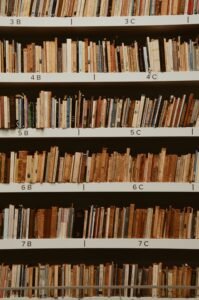
This is the closest thing to running your own small Dewey Decimal operation. Crime novels together, biographies in their own corner, nature writing cosying up with itself. Category Purists tend to be wide, serious readers who think in categories, and they usually have very strong opinions about whether poetry deserves its own shelf or should be filed under literary fiction. If you’ve ever felt genuine discomfort seeing Aristophanes, the ancient Greek playwright, sandwiched next to an airport thriller, you’re one of them.
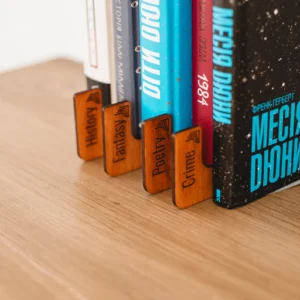
Courtesy: Etsy
3. The Rainbow Architect
Walk into a home with a rainbow bookshelf and you’re looking at someone who thinks of their books as art first and inventory second. Critics have accused Rainbow Architects of caring more about how a shelf photographs than what’s actually inside it, and the debate has run hot enough that Slate once published a piece called “Arranging Your Books by Color Is Not a Moral Failure”. But designer Marie Cloud makes the fairer point: people get this invested in shelving because a bookshelf is personal expression, not just function, and colour-coding is one more legitimate way to make a room feel like yours. The trade-off is real, though. Somewhere in that beautiful gradient is a specific green paperback you need for a book club tonight, and you will spend twenty minutes finding it.

Courtesy: Livingetc
4. The Sentimental Shelver
This person’s bookshelf makes no sense to a stranger and complete sense to them. A dog-eared childhood copy of a book they’ve long outgrown sits beside a hardcover a friend gifted for a birthday years ago, kept less for the story and more for the inscription on the first page. They are keepers of ghosts who rarely organize by genre, colour, or alphabet, because their real filing system is memory. Ask them why a particular paperback with a broken spine still has pride of place, and you’ll usually get a story that has nothing to do with the plot.
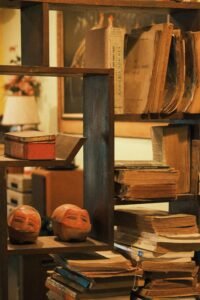
5. The Time Traveller
Some people shelve books by publication date, decade by decade, so the spine of their collection literally tracks the history of the novel. Others sort by when they personally read something, which turns the shelf into a diary written in spines instead of pages. Either way, this is a person for whom a bookshelf works as a timeline rather than a static object, quietly doubling as a form of memory-keeping.
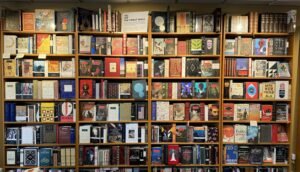
Courtesy: Books of Titans
6. The Beautiful Disaster
Books stacked sideways on top of the neat rows. A paperback wedged spine-in because it was the only way it would fit. No system anyone else could reverse-engineer, and no interest in building one. It looks chaotic, but talk to this person for five minutes and you’ll usually find someone who reads constantly, buys on impulse, and finishes a book fast enough that shelving it properly feels like a waste of the time they could spend starting the next one. The mess usually comes down to velocity rather than neglect.
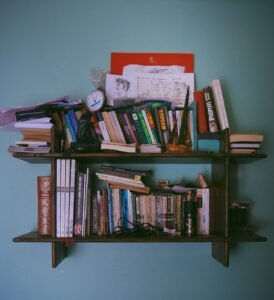

Courtesy: Reddit
7. The Antilibrarian
And finally, the person whose to-be-read pile has quietly outgrown their already-read shelf, stacked on the nightstand, the floor, sometimes the good chair nobody’s allowed to sit in. Taleb would tell you this is the healthiest shelf in the house, since an ever-growing stack of unread books means you’re still curious enough to keep buying evidence of everything you don’t yet know. It might not look organized, but it may be the most honest shelf of all, since it admits, openly, that the reading list is longer than the life. If your own TBR pile has started to feel like a small monument you’re not sure whether to be proud of or embarrassed by, we’ve gone deeper into the psychology of exactly that in The Psychology of the TBR Pile.
However you shelve your books—alphabetically, chromatically, chaotically, or not at all—you’re leaving a small, honest record of who you are and who you’re still trying to become. Next time someone visits and starts scanning your shelves, let them look. It’s one of the more truthful conversations you can have without saying a word.


I have visited some friends’ house with bookshelves in their room/hall but never really gave it a look. I’m not really a reader so I have always associated bookshelves as a sign of someone being very intellectual and good at English, but never really thought about it this way. A bookshelf, more like a mirror to the owner’s personality, that sounds so interesting to observe.
Next time when I’ll see a bookshelf, I’ll make sure to read atleast the titles which would give me a little hint of what a person might or might not like.
It always feels good to get a call-back from one of your blogs. Reading the word ‘antilibrary’ from the sub-topic “The Art Of It” instantly reminded me of the other blog of yours—The TBR pile.
It feels like a multiversal collision when points from your previous blogs connects to the new one, or when a topic gets a spin off.