
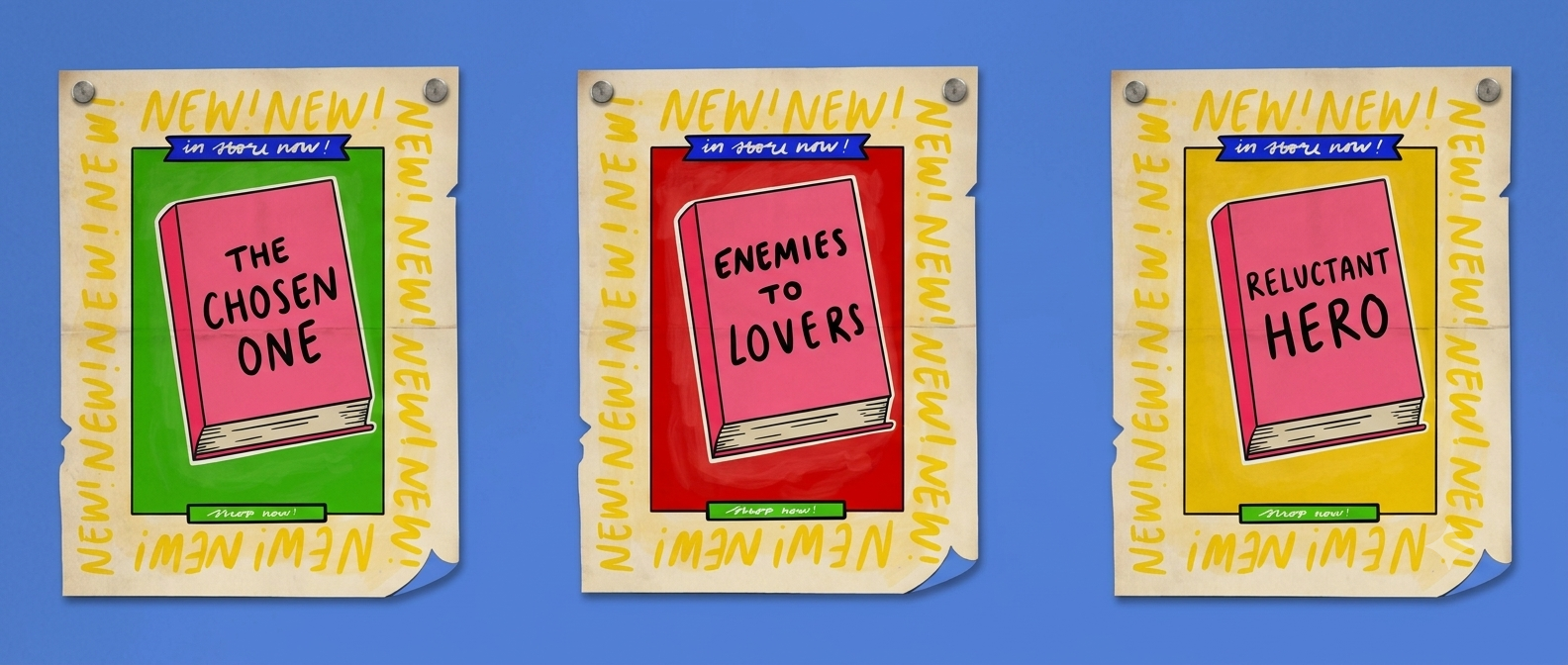
I know somewhere on BookTok, you’ve spotted that girl holding up a whiteboard reading “enemies to lovers” in glitter gel pen and people fawning over it in the comments. On the other hand, a critic sighs into their coffee because a novel just said, “the chosen one shall save the world”. Both are talking about tropes, the recurring patterns and devices that show up across stories again and again. A trope is not a cliché by default. It is closer to the sargam: every song uses roughly the same seven notes and its mutations, but what separates a masterpiece from elevator music is what the artist does with them.
What a trope actually is
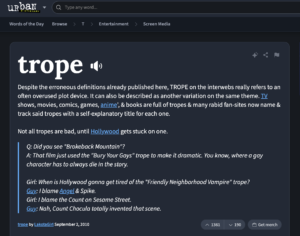
Courtesy: Urban Dictionary
A trope is a recognisable narrative building block: a plot shape, a character type, a recurring image, or a structural device, that appears so consistently in stories that they’ve been categorized under literary categories called tropes. The chosen one. The wise mentor who dies halfway through the story. The love triangle. The unreliable narrator. The ghost who is also a metaphor for grief. None of these are inherently good or bad. TV Tropes, the internet’s unofficial encyclopaedia of narrative devices, catalogues thousands of them precisely because storytelling across cultures and centuries keeps reaching for the same tools.
Courtesy: Mussé Musings
Why tropes are unavoidable
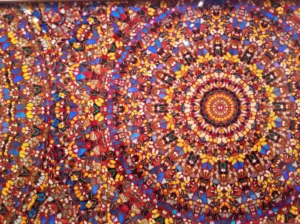
“There is no such thing as a new idea. It is impossible. We simply take a lot of old ideas and put them into a sort of mental kaleidoscope,” said Mark Twain. No writer invents language from scratch, and no writer invents narrative structure from scratch either. Aristotle was already describing the three-act structure in the Poetics over two thousand years ago. Every romance carries some echo of star-crossed lovers. Every mystery carries some echo of the locked room. A writer sitting down to draft a story is not choosing between tropes and no tropes. They are choosing which tropes, and how consciously.
“Originality” in fiction rarely means inventing a device nobody has used before. It means combining familiar devices in a way that feels newly alive—a mental kaleidoscope. Shakespeare took existing Italian and Roman plots and rebuilt them into Romeo and Juliet and Hamlet.
Thus, tropes existed since the beginning of human imagination itself. There are certain patterns and rhythms in narratives that the mind is intrigued by. Melding and mixing those tropes is what creates the right concoction.
Tropes as tools, when used well
A trope, in skilled hands, becomes shorthand that lets a writer skip the boring parts of setup and get straight to meaning.
- Readers already understand the shape of a “reluctant hero” story, so a writer can spend pages subverting or deepening that shape instead of explaining it from zero.
- The unreliable narrator turns the reader into an active participant, hunting for the gap between what is said and what is true.
- The frame narrative lets a writer play with memory, distance, and who controls a version of events.
- The domestic tragedy, a family falling apart under ordinary pressure, turns something small into something universal.
- Magical realism, treating the impossible as mundane, lets a writer smuggle political and historical weight into the fantastical.
Where award-winning fiction uses tropes brilliantly
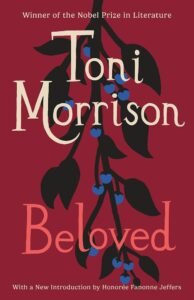
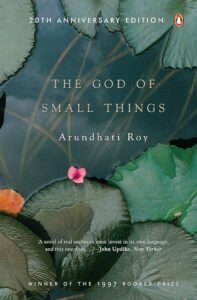
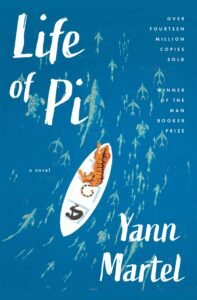
Courtesy: Amazon Books
Books that win the Booker Prize or the Nobel Prize in Literature are almost never trope-free. They are trope-aware.
- Yann Martel’s Life of Pi (Booker Prize, 2002) leans on the unreliable narrator, structuring the whole novel around which version of a survival story a reader would rather believe. The Booker Prize’s archive still calls it one of the prize’s most argued-over winners.
- Arundhati Roy’s The God of Small Things (Booker Prize, 1997) uses the forbidden love and fractured family tropes, both centuries old, filtered through a non-linear structure so specific to Kerala and to childhood that the familiar shape turns unrecognisable.
- Toni Morrison’s Beloved (Nobel Prize, 1993) takes the ghost story, one of the oldest tropes there is, and turns it into a reckoning with slavery, quite masterfully and with a lot of heart. She also tunes the trope of a sacrificing, nurturing mother upside down to reveal how something as pure as motherhood can be tainted under conditions where love is forbidden.
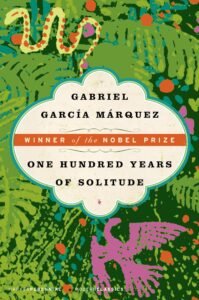
- Gabriel García Márquez’s One Hundred Years of Solitude (Nobel Prize, 1982) built magical realism into a household name by treating the family saga as myth rather than domestic drama.
What links these books is that they make tropes the argument of the book. The story is carried forward by excellent characterization, unique storytelling, and tropes that have been unravelled exquisitely.
Where trope culture goes wrong
Once readers can categorise a book by its trope alone (grumpy x sunshine, fated mates, found family), some writers start building backward from the label instead of forward from an idea.
- Formula replaces feeling. A plot beat happens just because the trope demands it, not because the story needs it.
- Character becomes type. The manic pixie dream girl, the brooding bad boy, the sassy best friend, flatten into predictable functionalities rather than a meticulously built psychology of a person.
- Predictability kills tension. Once a reader can map the whole arc from the trope alone, the book stops asking anything of them.
- Marketing eats craft. Books get pitched by trope combination first, pressuring writing toward whatever is trending rather than what the story needs.
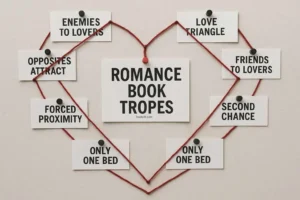
Courtesy: The Book Club
Courtesy: Joy Media
When tropes turn harmful
Some tropes calcify into stereotype, and that’s when it starts to damage not just the story but real bodies and perspectives.
- The Magical Negro: a Black character who exists to dispense wisdom and fix a white protagonist’s problems, then vanishes without an inner life. Spike Lee named the pattern in 2001; Wikipedia’s account traces it back centuries.
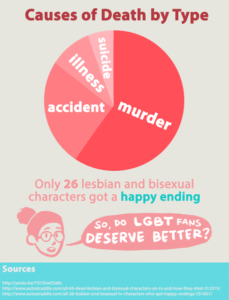
- Bury Your Gays: queer characters, especially lesbian and bisexual women, killed off at disproportionate rates. An Autostraddle study cited on Wikipedia found 35% of shows featuring lesbian or bisexual characters killed them off, against only 16% granting a happy ending.
- The exoticised “other,” where South Asian, East Asian, Middle Eastern, or African characters get written through a Western gaze as costume or threat, not lived reality.
- The disposable minority character, written shallow or expendable, a pattern that researchers at BYU flag as among the least discussed forms of harm in popular fiction.
- Disability as metaphor, used to symbolise a character’s moral state rather than written as a lived condition.
None of this means these identities cannot be written about. The difference between representation and harm usually lives in whether a character is a person the story is curious about, or a device the story is using.
Trope culture as a marketing engine
Trope culture became a business model, largely through BookTok, the corner of TikTok where readers rank and recommend books to audiences in the millions.
- NPD BookScan found combined sales for BookTok-featured authors more than doubled in 2021, and Slate reports sales climbed a further 50% by mid-2022, per the New York Times.
- Trope-ification has become a pitch strategy. Publishers write synopses around trope tags, and authors describe agents asking them to write toward whatever combination is currently trending.
- BookTok gave indie and debut authors a shot at virality traditional budgets never offered, broadening readership for micro-genres and forgotten backlist titles.
- A book gets fifteen seconds to announce itself as “enemies to lovers meets found family” instead of describing what it is actually about, and some authors worry this rewards packaging over story.
So, tropes: friend or foe?
Neither, really. The difference between a Booker-winning novel and a forgettable one using the exact same device comes down to specificity: whose voice, whose history, whose particular ache gets poured into the shape. Roy’s forbidden love is not Shakespeare’s. Ishiguro’s unreliable narrator is not Nabokov’s. Each book’s personality is its art.
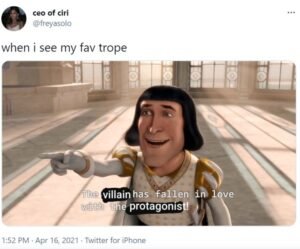
The next time someone rolls their eyes at “just another enemies to lovers book,” it is worth remembering that Pride and Prejudice is arguably the trope’s most famous ancestor, and nobody has managed to cancel that one yet.
Courtesy: Pinterest


Actually this blog is not only informative for authors/readers but also for people indulge in other art forms. Tropes (now I’ll remember what’s it called) are there in alot of art forms including cinema, and I feel after the pandemic — which gave the biggest possible boom to the internet, people are now aware about more tropes than before (maybe also when it comes to books). So from what I understand, maybe one should acknowledge it more than to ignore it, and also that a trope won’t affect the artwork negatively if it’s wrapped with a unique or one’s own way of storytelling. As you said, maybe that’s why “The God of Small Things” and “Pride and Prejudice” worked.
Wow I learnt a new word today, might use it now to sound cooler 😝