
Every reader has a hill they’ll die on. Here are ours. Pull up a chair, pour some chai, and disagree with us in the comments, that’s half the fun.
-
We praise “fast-paced” books too much
Storytelling is an art, and as readers we owe it to ourselves to appreciate the many different ways art can speak to us. A fast-paced book gives you the adrenaline rush, the propulsion, the energy of a story you can’t put down. But a slow, deliberate build, one that takes its time laying brick by brick, is often the more immersive experience, not the lesser one. Great slow-paced books trade rapid plot events for deep characters, lush atmosphere, and prose you want to underline. Think Marilynne Robinson‘s Gilead, unhurried by design, or Kazuo Ishiguro‘s The Remains of the Day, where almost nothing “happens” and everything happens. These books aren’t meant to be rushed. They’re meant to be steeped in, like tea.
-
Not every bestselling book needs a movie or TV adaptation
Sometimes books need to be allowed to just be books. Not everything benefits from being translated into a different medium: some stories live entirely in the space between the page and your imagination, and that space is the point. (And can we talk about how uneven the Percy Jackson films have been, given how beloved the source material is? They’re hardly alone. Eragon, Artemis Fowl, and The Golden Compass all landed with the kind of critical and fan backlash that makes you wonder why the book even got picked in the first place. Some stories are better left living entirely rin your head. Wuthering Heights is a whole separate debate: nearly a dozen adaptations since 1939 and still no version fans agree actually captures it, which might say more about the novel’s untranslatable strangeness than about any single film’s failure.)

-
Books don’t need to be “relatable” to be life-changing
We’ve overcorrected into treating relatability as the highest compliment a book can receive. But some of the most life-altering reads are the ones that show you a life nothing like your own: a different country, a different century, a different set of impossible choices, and hand you a wider frame for understanding your own. Reading Khaled Hosseini‘s A Thousand Splendid Suns and following a girl surviving war in Afghanistan while you’re curled up somewhere in Greenland with a mug of Greenlandic coffee (that strong, whiskey-and-whipped-cream dessert drink locals serve at the end of a meal) is precisely the kind of distance that makes a book matter. A book doesn’t have to mirror you to change you.

-
Libraries deserve as much love as bookstores
Bookstores get all the aesthetic, candle-lit Instagram energy, but libraries are the original democratizing force in reading. They’re hubs of discovery and quiet community. You walk the aisles running a finger along the spines, breathing in that particular smell of aged paper and old knowledge, not entirely sure what you’re looking for until it finds you. Every book you borrow carries the fingerprints of everyone who checked it out before you.

You go in looking for one thing, and something entirely unrelated catches your eye on the way, and somehow you walk out with sixteen books stacked in your arms, already relishing which one you’ll crack open first. And there’s something almost sacred about the due date. It builds a small, useful urgency into an otherwise slow art.
-
Not every unlikeable character needs a redemption arc
Writing a genuinely unlikeable character well takes more psychological precision than writing a likeable one: you have to make cruelty or pettiness feel human rather than cartoonish. So why do we keep insisting these characters be softened by the final act, revealed as secretly good, secretly grieving, secretly redeemable? Let villains be villains. Think of Cathy Ames in Steinbeck‘s East of Eden, written as something close to pure malevolence and never softened into sympathy, or Amy Dunne in Gone Girl, who stays gloriously, unrepentantly monstrous all the way to the last page. Humbert Humbert in Nabokov‘s Lolita is compelling precisely because Nabokov refuses to let his eloquence become an excuse. None of them need saving to be worth reading. Love them for the craft it took to build them, not for a last-minute reveal that they were misunderstood all along.
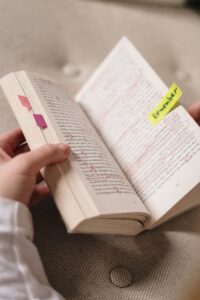
6. Annotating your books isn’t disrespecting them, it’s actually reading them
Reading is a two-way conversation, not a one-way transmission. You have to meet the author and their characters on the page, and annotating is how that meeting happens. There’s no single right way to do it, either. The underliner drawing a single clean line under the sentence that stopped them cold, the margin-scribbler arguing back at the author in half-finished thoughts, the sticky-note hoarder color-coding by emotion, the dog-earer who just wants to find the page again, the reader with a pencil doing quiet close-reading, annotating symbols and questions like it’s a puzzle to solve. Whatever the method, marking up a book is the deepest kind of intimacy a reader can offer it.
7. Audiobooks count as reading
If the story is taken in fully, the words, the emotional arc, the meaning, it counts, regardless of whether it entered through your eyes or your ears. The science backs this up more than the skeptics want to admit: a 2019 UC Berkeley neuroscience study scanned listeners’ and readers’ brains processing the same stories and found the resulting brain maps were nearly identical. And a widely cited 2016 study by researcher Beth Rogowsky found no significant difference in comprehension between reading, listening, and doing both at once. Complex, information-dense texts are where audio can lose a little ground, so pairing print with audio for the genuinely thorny stuff isn’t a bad idea. But for narrative fiction? Put your commute, your dishes, your gym session to work. You’ll get through your copy of Sapiens faster, and you’ll remember more of it than you think: a good narrator’s delivery can carry meaning and emotion a silent page can’t.
-
Classic literature isn’t automatically better than what’s being written right now
Classics endure because they’ve survived the test of decades, sometimes centuries, but longevity isn’t the only measure of greatness, and it definitely isn’t a referendum on contemporary fiction. Some of the most emotionally exact, formally daring writing of the last twenty years has come from working authors: writers experimenting with structure and voice in ways the classics never had to (nonlinear timelines, second-person narration, novels-in-stories), while still landing the same gut-punch emotional precision readers credit the greats for. That’s not a lesser achievement just because it’s recent. Look at Khaled Hosseini, Markus Zusak, John Green, but also Elena Ferrante, Colson Whitehead, Ocean Vuong, Yaa Gyasi. Being contemporary doesn’t make a book disposable. Give the shelf next to the classics section its due.
-
Short story collections deserve way more respect than they get
Have you read the book that won the International Booker Prize last year? Heart Lamp, Banu Mushtaq‘s collection of short stories translated from Kannada by Deepa Bhasthi, became the first collection of short stories to win the International Booker Prize: proof that the form isn’t a lesser cousin to the novel, just a different instrument. A collection gives you a fresh start every time you close one story and open the next: new voice, new rhythm, new emotional register, without asking for the four-hundred-page commitment a doorstop novel demands. If thick books lose your attention halfway through, short fiction is not a compromise. It’s a genre worth seeking out on its own terms.
-
Rereading your favourite book is not a waste of time you could spend on something new
Of course it isn’t. It’s the literary equivalent of a hug from an old friend. Coming back to lines you already love is like drinking chai on a slow Sunday morning, nothing new needs to happen for it to be worth doing. And you’re in good company: a survey by The Reading Agency found that more than half of readers had reread at least one book in the past year, and over a third said rereading simply made them happier, a number that climbs even higher among readers under 25.
There’s a reason it works this way. A first read is discovery, you’re racing to find out what happens. A reread is something closer to therapy. You already know the ending, so your nervous system can finally exhale, and all that freed-up attention goes toward noticing what you missed the first time: a foreshadowed line, a joke that lands differently now, a character’s grief that makes more sense once you’ve lived a little more life yourself. Psychologists who study rereading describe it as a way of meeting an old version of yourself on the page and measuring how far you’ve come. It’s comfort, yes, but it’s also a quiet form of self-reflection dressed up as nostalgia, which might be the best kind of healing there is.
11. Bonus: A translator deserves almost as much credit as the author for how a translated book reads
This is the opinion we’ll fight hardest for. A translator doesn’t just carry words across a language border, they decide how much of the original culture survives the crossing, and that decision changes the entire reading experience. When Heart Lamp won the International Booker, the prize (worth £50,000) was split evenly between Mushtaq and Deepa Bhasthi, which tells you something about how the industry itself weighs their contributions. In her translator’s note, Bhasthi describes her approach as being “against italics,” refusing to visually flag Kannada words as foreign imports, trusting readers to sit with unfamiliar language rather than smoothing it into “comfortable” English. That single choice changes the texture of every page.
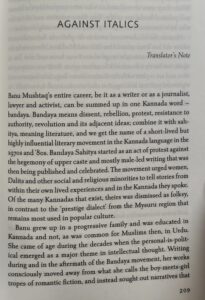
Except from Translator’s Note “Against Italics” in Banu Mushtaq’s Heart Lamp translated by Deepa Bhashti
You see the same stakes in Daisy Rockwell‘s translation of Khadija Mastur‘s Urdu classic Aangan, published in English as The Women’s Courtyard. Rockwell didn’t just retranslate a novel that already existed in English, she wrote an extended translator’s note explaining exactly where and why her choices departed from the earlier translation, arguing that clarity and restraint in Mastur’s prose had been over-embellished the first time around. Read both translations side by side and you’re not reading the same book twice. You’re reading two different arguments about what the original was actually trying to say. Not just a footnote to the reading experience, but it is the reading experience, and it’s about time we said so.
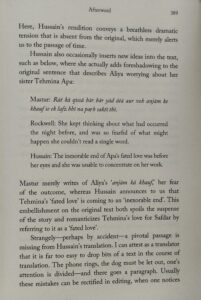
Excerpt from Translator’s Note in Women’s Courtyard by Khadija Mastur translated by Daisy Rockwell
What’s your most unpopular bookish opinion? Tell us why we’re wrong.



I sooo agree with you on this, woudn’t have before…This blog reminded me of one of your previous blogs, which was about busting myths. I love it when you write about myths and opinions which I thought were true—only until I read the blog.
I also agree with your point “library deserves…” as that’s what we used to look forward to, during school times. Going and sitting in a library has always felt far better than sitting in a bland classroom.
This blog taught me how important a translator’s work is and how under-appreciated one is. Translators are so important, yet so unrecognised. I am glad I am now aware of their importance.