

“Fill your paper with the breathings of your heart.” — Rabindranath Tagore
Thinking about self-publishing your first book but not sure where to start? Here’s exactly what the process looks like—from first draft to bestseller list.
Publishing, to many, would seem a mammoth task, something that at the beginning seems dreadful, chaotic, even a little scary to those who are new to it. And that’s not completely wrong. After all, it does take a village to raise a book. But if the village offers you complete control over your book, 100% profits, and tailored packages to help you edit, print, and distribute your story to the world without giving up your rights, it starts to feel a lot less daunting.
That is what self-publishing is. It’s often seen as the “last resort” for writers who couldn’t land a deal, but it’s really an entrepreneurial path. You become the CEO of your own product, the book, the one you invest in and own completely. You can hire individuals or a publishing house to edit, format, and design your book, and even run your marketing for you.
The process is streamlined, and from start to end, you are the boss. Here’s what that journey actually looks like, step by step.
Before any of the steps below, though, comes the part only you can do: writing the book. Once you’re done with this bit, the rest is easy sailing. Right? Well, not quite. There’s still a lot happening backstage that leads to the birth of your favourite books.
Step 1: Registration and Consultation
Once your manuscript is ready, the first real step is registration and consultation with your publishing house. Before that, though, comes a decision that shapes everything else: choosing the right team. Not every publishing house is the right fit for every book, so it’s worth looking at their past work, the genres they specialise in, and how involved they let you be in your own project, since they’ll be your partner for the whole journey.
Once you’ve found the right fit, the consultation is where you sit down with your team and talk through your book. A good team won’t just take notes, they’ll ask questions and push back where needed, so they genuinely understand your vision before a single page gets designed. This stage is also where the logistics-heavy work happens. Your book needs a unique identifier called the ISBN, and acquiring one is one of the first things your team takes care of, registering your book so it gets its own distinct code for each edition, whether that’s the e-book, paperback, or hardcover.
All of this can sound complicated and jargon-heavy, but with the right team by your side, they’ll take care of the mess. All you need to do is stay driven and bring in the book of your dreams.

Step 2: Design and Formatting
Once registration is sorted, your book moves into design and formatting. This is where your story starts looking like an actual book.
They say you shouldn’t judge a book by its cover, but we all do, don’t we? Walking through a bookstore, or scrolling Kindle, it’s the cover that catches your eye that ends up being read. That’s why it matters so much that your book cover designer translates your story’s soul onto its cover and does it justice. A professional designer will create a genre-specific, high-converting cover that fits your vibe, whether that’s minimalistic, aesthetic, fantastical, or practical.
Formatting is another important piece that many tend to gloss over. A book should feel comfortable to read. The font that suits your story, how your chapter titles look, whether your page numbers sit left, right, or centre, whether or not you want a chapterised index, it all matters in making your book look top-notch.
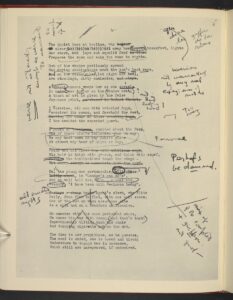
The manually edited draft of T.S. Eliot’s ‘The Waste Land’ before it went on to become the most important poem of the 21st century
Step 3: Review and Approval
Next comes review, which covers editing and proofreading. Editing does not mean stripping your book of all its
soul and originality and turning it into a grey, corporate mess. It’s the process that enhances your story by cat
ching the plot holes you’ve missed and fixing them. As the parent of your book, you’ll always subconsciously overlook a few of its shortcomings, and having a fresh pair of eyes read it does a great deal to fix story arcs, pacing, character development, and structural gaps. You may have to go through multiple rounds of editing to get to the best possible draft of your story. After all, “Easy reading is damn hard writing,” as Nathaniel Hawthorne says.
Review also includes proofreading, which handles the basic things that define the quality of a book: missing commas, misspelt words, or messy punctuation. Proofreaders comb your manuscript for every possible error or inconsistency to help your book reach its fullest potential.
Once editing and proofreading are done, you get to review the final version of your book, cover included, and give your approval. Nothing moves ahead without your say-so. This is still your book, and you have the final word.

Step 4: Pre-order, Launch and Distribution
With your book approved, it’s time to get it out into the world. Many authors open pre-orders before the official launch date, which helps build early buzz and gives your first readers a reason to show up on day one.
Then comes launch day, which is genuinely the best part. All the blood, sweat, and tears have finally brought your book to fruition, and it’s ready to be held in your hands, straight and hot off the press. Your book is no longer a document on your laptop and is transformed into a real, living, breathing entity, ready for your bookshelf. From there, your publishing house distributes it to retailers and online platforms, so readers everywhere can buy it, read it, and love it.
Step 5: Marketing and Promotions
Getting your book out there is only half the job. The other half is making sure people actually find it. You need to find your tribe. To drive sales and attract an audience, you curate a launch plan with your publishing house: promotions, newsletter and blog features, social media announcements, book-signing events, ad campaigns, and everything else it takes to pave your path to stardom.
Step 6: Royalty and Support
Here’s a part first-time authors don’t always know to expect: the relationship doesn’t end at launch. Once your book starts selling, you earn royalties on every copy sold, and a good publishing house will keep you updated with clear, regular reports so you always know how your book is doing.
You’ll also have ongoing support well after publishing day, whether that’s help with reprints, questions about your rights, or guidance on what to do next. Self-publishing isn’t a one-time transaction. It’s a long-term partnership, and the best teams stick around for the long run.
And there you have it, the entire self-publishing process, from your first consultation to your first royalty cheque. It isn’t always a quick road, but it is entirely yours: your story, your cover, your terms, your profits. All that’s left now is to start writing.





A perfect blog to not just help you understand the road to publishing a book, but also encourage you to go for it. Never knew there are so many steps and hurdles one needs to go though before bringing a book to life. Really well written and fun to read, Ms. Anoushka Garg ✨
This is an excellent, encouraging roadmap that would find a very appreciative audience on a publishing blog, a newsletter, or a medium platform for aspiring writers.
awesome article, learned a lot :)
What an amazing initiative by Ms. Anoushka garg to provide information about something that most of the writers dont know how to get into. Im really happy to know that the young writers will not get lost in the marketting world with no knowledge. Excited to see this work out
Such a helpful article, great way to help develop insight into a topic that can easily feel so overwhelming! Kudos to Ms.Anoushka Garg!
Thank you for writing this!
This is the clearest, step-by-step guide for newbies. Self-publishing is truly a long term task, but you help make it sound doable <3
More of this please. Especially how much time and money it can cost overall!
For sure, Ishita! More informative blogs on the way. If you have any other queries, do contact Paper Towns! :)
[…] To find out more about what that process actually looks like, check out our blog on the self-publishing process. […]
This blog was exactly what I needed. Extreme thanks to Ms. Anoushka for providing us with this blog full of utterly important information which is very useful for first time authors, this blog helped me out a lot . Will soon try to implement this.
Sounds great, Tanishqa! Wishing you the best. If you need any more info, contact Paper Towns! :)
Amazingly written and incredibly informative, especially for people who genuinely want to learn about self-publishing but don’t know where to start or how the whole process works. I really liked how you broke everything down into clear, easy-to-follow steps without making it feel overwhelming. The flow is smooth, the writing is engaging, and it strikes a great balance between being informative and easy to read. Overall, it’s very well-written and well-researched. Great job!!
This blog was really a masterclass as to how someone should delve into the world of self-publishing without doubting themselves ever. Every phase is explained so eloquently that one may find this as a starting point to confiding in themselves. So very proud of Anoushka
Loved how clearly each step is explained. Informative, encouraging, and genuinely helpful for anyone dreaming of publishing their first book! Well done Ms. Anoushka Garg!
[…] what the self-publishing side of this actually looks like in practice? We’ve mapped out the whole process here, from registration and consultation right through to royalties and ongoing support. And if […]
[…] If you wish to know in detail about the process of self-publishing, from start to end, read our blog here. […]
The section provides useful context for technical market analysis.
Social Security Calculator
gives me the courage and motivation to start my publishing journey as well. very inspiring :)
great blog! loved it