
Somewhere in Rohini, Delhi, there was a printing press that had been quietly running for who knows how long, churning out unauthorised copies of Sapiens, Atomic Habits, and The God of Small Things like it was nobody’s business. Then, in March this year, it very much became somebody’s business. Penguin Random House India, working alongside Simon & Schuster India, Hay House, and Delhi Police’s Crime Branch, raided the operation and seized over 20,000 pirated books in a single, nearly day-long sweep, arresting one man and registering a formal case under the Copyright Act. By most accounts, it’s one of the biggest anti-piracy actions the capital has seen.

Courtesy: The Jamia Times
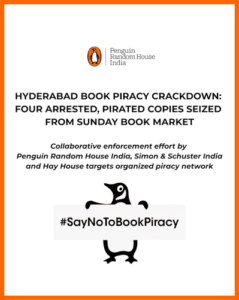
It didn’t stop there. In July, a smaller but similarly coordinated raid hit Hyderabad’s Sunday Book Market, a beloved haunt for anyone who has ever hunted for a battered secondhand paperback under a tarpaulin stall, resulting in four arrests and over 300 pirated books seized. Penguin, it seems, is no longer content to quietly issue takedown notices to shady websites; it’s going after physical markets, printing presses, and the people who run them.
Courtesy: Penguin Random House
On paper, this looks like a straightforward win for authors and copyright law. In practice, it has opened up a debate that is messier, more interesting, and far more urgent than “piracy bad, crackdown good.”
The Defence of the Book Bazaar
Here’s the thing about book piracy in India: it rarely looks like some shadowy cybercriminal operation. It looks like a Sunday market, the photocopy shop outside your college gate, the uncle who sells “originals” at half price near the railway station, no questions asked. In the popular imagination, these aren’t hardened villains; they’re often the only reason reading has stayed affordable for a huge number of Indian readers.

Courtesy: The Business Standard
So when the raids made headlines, the reaction wasn’t universal applause, quite the opposite. Commentators pointed out that the seized titles included authors whose last book came out four, sometimes twenty-six years ago, hardly evidence of active market cannibalisation. A widely shared piece in the Deccan Chronicle quoted an activist comparing the crackdown to a landlord evicting a squatter and congratulating himself for it, arguing that readers were being priced out of a system that treats knowledge as private property. On Bookstagram and Substack, readers and independent booksellers kept circling back to something publishers don’t love discussing out loud: prices have gone up, sharply, and readers noticed.
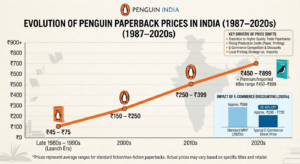
A widely circulated Instagram carousel from The Bookshop, quoted at length on Substack, pointed out that Penguin Random House India began pricing its books close to their pound or dollar equivalents from April 2025 onward, pushing the average paperback from roughly ₹500-600 to something closer to ₹1,000. For a student, a first-jobber, or honestly anyone who reads more than one book a month, that’s the difference between a reading habit and a reading indulgence.
Courtesy: Penguin Books India
That’s really the heart of the pushback, distilled into one sentence someone left in a comments section: you cannot price readers out of literacy and then act shocked when they find another way in.
We Cannot, However, Wave the Piracy Flag
Let’s be honest about the other side of this too, because it matters just as much. Piracy is not some Robin Hood act of literary justice. Every pirated copy sold is a copy that doesn’t put a rupee into the pocket of the person who spent years writing it. Authors already occupy one of the more precarious corners of the creative economy, where royalties are thin, advances are thinner, and most writers aren’t living off their book sales the way readers assume. When piracy eats into that margin, it punishes not some faceless corporation but the writer two years into a manuscript, wondering if this book will even earn out.
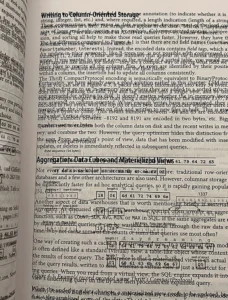
There’s a quieter cost too: pirated editions are notoriously shoddy, with smudged ink, missing pages, garbled formatting, and sometimes entire chapters dropped, which changes how a book is experienced, and rarely for the better.
Courtesy: New York Post
Romanticising the book bazaar as some noble resistance movement doesn’t hold up under scrutiny, and neither does pretending the crackdown alone solves anything. It doesn’t address the actual reason the bazaar exists in the first place, which is that people want to read and the legitimate industry has made that increasingly hard to afford.
Reading Was Already in Trouble. This Doesn’t Help.
Here’s the uncomfortable backdrop to all of this: reading habits, in India and globally, have been quietly declining for years, squeezed out by shorter attention spans, cheaper entertainment alternatives, and cost. India is estimated to have over 46,000 public libraries, a number that looks reassuring on paper but rarely translates into meaningful daily access. Book banks near college campuses and neighbourhood lending libraries in cities like Chennai and Mumbai have stepped into that gap, but they remain concentrated in big cities, more an urban privilege than a national infrastructure.

Raising prices on top of that already-fragile ecosystem does more than make books more expensive; it quietly redefines reading as a middle-class-and-up hobby, something you do because you can afford to rather than because everyone deserves access to it. Publishers should find that far more worrying than piracy, since a shrinking reader base is a much bigger long-term threat to the industry than a Sunday bazaar in Hyderabad.
So What Can Penguin (and Every Other Publisher) Actually Do?
Outrage alone, from either side, doesn’t put a single book into a single new reader’s hands. A few directions worth taking seriously:
-
Tiered and regional pricing, done properly.
Publishing houses already do this for international markets to some extent, but there’s room to go further with genuinely localised pricing for Indian editions that reflects Indian purchasing power rather than currency conversion optics. A ₹1,000 paperback, in a market where the median monthly wage is what it is, reads less like a pricing decision and more like a gatekeeping one.
-
Invest visibly in library infrastructure.
Publishers could partner directly with state library systems, book banks, and community lending libraries as a genuine distribution channel rather than a CSR afterthought. Normalising reading through a library the way people have normalised reading through Kindle Unlimited would strip piracy of a huge chunk of its appeal.
-
Affordable digital-first editions.

Courtesy: CNET
E-books and audiobooks priced meaningfully lower than print, and released alongside it rather than as an afterthought, give price-sensitive readers a legal, comfortable alternative instead of pushing them toward a pirated PDF because that’s the only accessible digital option going.
-
Bring back genuinely cheap paperback lines.
Publishers used to run budget imprints specifically for backlist and older titles, the kind of low-cost, low-frills editions that kept reading widely accessible. Reviving that model for older, non-frontlist titles, the very ones that turned up in these raids, would directly undercut the piracy argument for those specific books.
-
Transparency about where the money actually goes.
Much of the anger around pricing comes from a simple information gap, since readers rarely know how much of a book’s price is printing, distribution, marketing, or author royalty. A little honesty here could reframe the conversation from “publishers are greedy” to an actual explanation of cost, inviting dialogue instead of blanket resentment.
-
Partner with, rather than only prosecute, informal booksellers.
Not every Sunday bazaar vendor is a criminal mastermind; many are simply booksellers operating outside formal supply chains because those chains never reached them. Formal distribution partnerships, consignment models, or discounted bulk supply to these informal markets could convert competitors into legitimate retail partners.
-
Treat reading decline as the actual enemy.

Courtesy: The Pioneer
The industry’s energy might be better spent on campaigns, school partnerships, and reading initiatives that grow the overall reader base, rather than solely policing the black market for a shrinking pool of readers. A bigger, healthier reading culture benefits everyone, publishers most of all.
The Real Plot Twist
Nobody in this debate seems to want to say the obvious part out loud: publishers and pirate-book buyers actually want the same thing. One protects the economics that let authors keep writing; the other makes the price barrier disappear entirely, consequences aside. Neither side is fully right, and neither is quite the villain the other imagines.
Courtesy: The Signal Brief
The crackdown isn’t wrong to exist; theft of intellectual labour deserves consequences. But if Penguin and its peers want the raids to mean something beyond a headline followed by another bazaar popping up somewhere else next year, enforcement has to be paired with access. Punishing the printing press is the easy half of the job. Making sure a version of that same book still exists on the shelf next to it, one an ordinary reader can actually afford, is the harder, more important half.
The Indian librarian S. R. Ranganathan wrote his five laws of library science back in 1931, and one of them has aged into something closer to a warning than a principle: “every reader his book, every book its reader.” Nearly a century on, publishers seem to have quietly forgotten the second half of that sentence. A book that no one can afford to read isn’t really being read at all, however many copies of it get seized off a Sunday market table.

Courtesy: Scroll.in





Wow this really is a debatable topic. Before reading this blog, If anyone would have asked me, a clear straight answer would have been “piracy is wrong there’s no doubt in it”. Yes it is wrong, but the other side of ‘book piracy’ which everyone is unaware of, is what makes it debatable.
I’m so glad you wrapped your mind around this topic and put your thoughts and facts on it without being biased. Now that I’ve read about both the sides, I don’t know which is right and should exist….
I also agree that some books should have a lil less pricing, if possible and if it doesn’t affect the deserving revenue of the author. That would also work in favour of the book, as for instance, many times when people are travelling, they tend to purchase books from stalls to read during their journey.
This blog taught me how large the piracy network of books are, and it has it pros and cons and what are the ways piracy can me managed.
I really enjoyed reading this blog. ✨