
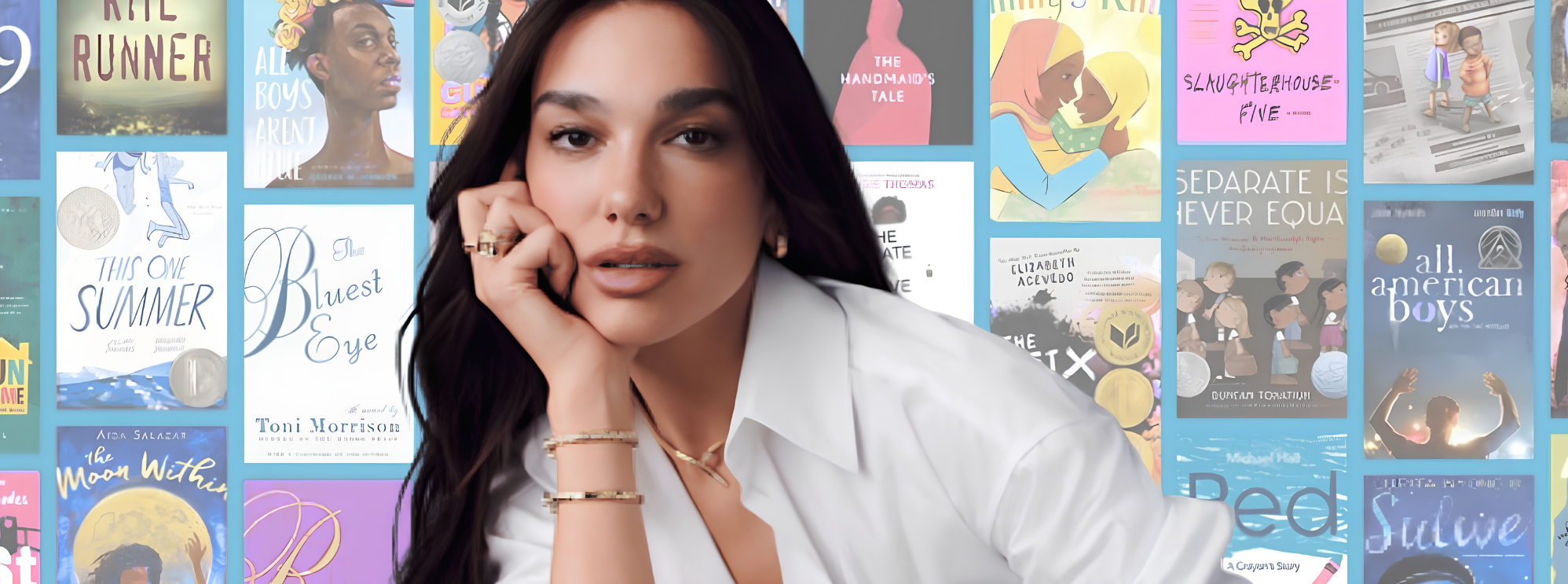
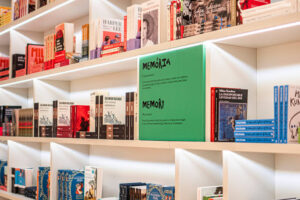
There’s a particular kind of irony in hiding a library. Not locking it, not guarding it, just tucking it away so quietly that even the staff have to be asked before they’ll lead you down a white stone staircase to find it. That’s exactly how you reach The Manifesto Library, the collection of one hundred banned and censored books that Dua Lipa has opened inside Livraria Lello, the 19th-century Porto bookshop so beautiful that tourists queue for timed tickets just to look at its staircase. You won’t find a sign. You’ll find a basement, a Pritzker Prize-winning architect’s cultural space, and shelves of the books someone, somewhere, decided you shouldn’t read.
Courtesy: Vogue Adria
That’s the quiet provocation at the centre of this project. A library that has to be asked for, in a building people already treat like a monument, holding books that governments and school boards have spent decades trying to make disappear.
Why a pop star and a 156-year-old bookshop
Courtesy: Tripadvisor
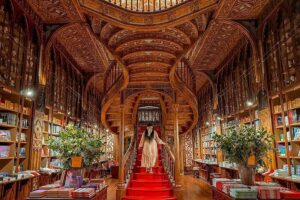
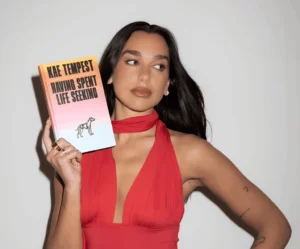
Livraria Lello was founded in 1869 by the French bookseller Ernesto Chardron, and it has spent over a century and a half being one of Portugal’s most photographed literary landmarks, regularly ranked among the world’s most beautiful bookshops, as My Modern Met noted when the library opened. Dua Lipa built The Manifesto Library here in partnership with the shop, as an extension of Service95, the book club she started in 2021. According to Euronews, it opened on 27 June as part of BABELL, Porto’s new international book festival, in a cultural auditorium designed by Álvaro Siza Vieira.
None of that is incidental. A pop star opening a library is a headline. A pop star opening a library inside one of the most reproduced, most Instagrammed bookshops on earth, and then hiding it in the basement, is an argument. The argument is roughly this: the books people fight hardest to erase are often the ones sitting closest to the surface of a culture that claims to already love reading.
The shelves themselves
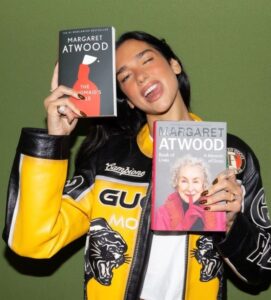
The hundred books are arranged around four themes, Power, Control, Voice and Memory, each one a different lens on what censorship is actually trying to protect, as I Love Libraries laid out in its coverage of the opening. Power holds books that ask who gets to define the story a society tells about itself, among them Simone de Beauvoir’s The Second Sex, Reginald Dwayne Betts’ Felon, Lea Ypi’s Free, and Omar El Akkad’s One Day, Everyone Will Have Always Been Against This. Elsewhere on the shelves sit the titles most readers will already half-recognise as controversial: Salman Rushdie’s The Satanic Verses, Margaret Atwood’s The Handmaid’s Tale, George Orwell’s Animal Farm.
To find out more about banned books that changed the world, a select list from Dua Lipa’s library, click to read this blog.
Courtesy: Ron Charles
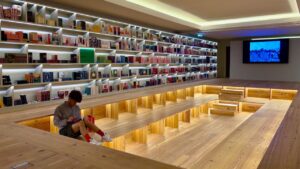
Critic Ron Charles, who visited the space in person for his newsletter, described a screen at one end of the room playing muted footage of protests alongside clips of Lipa in conversation with authors from the collection, among them Olga Tokarczuk and Percival Everett, while the only sound in the room is a soundtrack chosen by the Lello staff.
Lipa’s own words are printed on the wall of the space: this library, she writes, is “a shrine to books that have disappeared, to authors whose courage unmasks structures of power and control, and to readers who refuse to be told what book they are allowed.” Some titles were pulled from school districts over race or sexuality, others restricted for LGBTQIA+ readers, and for a few of the writers involved, she notes, the cost of the words was their life.
Courtesy: Ocula
For anyone who has followed Indian reading culture, that last point lands with particular weight. The Satanic Verses has been banned from import into India since 1988, before it was ever banned anywhere else, and Salman Rushdie has lived the consequence of that ban for most of his adult life. A library like this one doesn’t need to reach for Indian examples to make its point resonate here. The point was already made, decades ago, on our own shelves.
The obvious objection, and why it doesn’t fully land
Not everyone is convinced the framing holds up. National Review’s critique of the project points out, fairly, that many of the “banned” titles on Lipa’s list are bestsellers, assigned reading in classrooms, and sitting on shelves in most bookshops right now, which makes calling them contraband feel a little theatrical.
Courtesy: The Atlantic
It’s a reasonable jab, and worth sitting with rather than waving away. But it also misses the shape of the argument the library is making. A book being available in Porto or New York doesn’t undo the fact that it was pulled from a school library in Florida, restricted in a district in India, or banned outright by a government somewhere else on the map. Global availability and local erasure aren’t the same fight, and censorship has never needed to be total to work. It only needs to work in the one library, the one classroom, the one country where a reader would otherwise have found the book.
What a library like this is actually for
The real function of The Manifesto Library isn’t to shock anyone with how “banned” these books are. It’s to make the fact of banning impossible to ignore by putting the evidence in one physical room, four themes wide, and asking you to walk through it. Margaret Atwood writes, in the very book on these shelves, that ignoring something is not the same as being ignorant of it, that ignorance takes work. Ignoring a banned book is easy. Building a room, you have to specifically ask to enter, and stocking it with the voice someone tried to erase, is the harder kind of remembering.
I keep coming back to that basement. A hundred books someone tried to make vanish, sitting quietly under a beautiful bookshop, waiting for a reader to ask a staff member where they’ve gone. That, more than any statement printed on a wall, feels like the honest response to censorship. You go and find the book. You read it.
Courtesy: Overstandard

It needs a lot of courage to maintain such a library. Dua Lipa is not only an amazing artist but also a person of grit. This blog is very well written and powerful. Those of you who love books and are regular visitors to a library or a bookshop or own their own small libraries at home, this article is worth the read!
Getting a spin-off from your previous blog”20 banned books…” Is something in itself. Dua Lipa really did something there, choosing to get into a partnership for making a specific library for banned books and making books reach the readers they deserve. And applause to you for writing on it and letting us know about the one and only ‘The Manifesto Library’
This blog’s finding was a fact I was totally unaware of, that ‘George Orwell’s Animal Farm’ is also among the list of banned books.