When a book gets banned, it’s rarely about the book itself. It’s about the silencing of a voice sometimes too powerful for the world. The question of who gets to exist on the page, and whose story a small group of powerful people would rather erase becomes precarious. Books work as mirrors and windows: a mirror reflects a reader’s own life, a window shows them one that is nothing like it, and that’s usually where empathy gets built, long before a child has a word for it. Books like that are also what turn casual readers into lifelong ones.
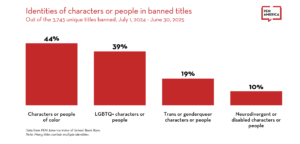
Courtesy: PEN America https://pen.org/report/facts-fiction/
PEN America The bans aren’t evenly spread, either. The most recent tracking of US school book bans found that 44% of titles pulled in 2024–25 featured characters or people of colour, the highest share it has ever recorded, with earlier analysis showing about a fifth directly tackled race and racism. The same tracking found 39% of banned titles included LGBTQ+ people or characters, with 19% featuring transgender or genderqueer people or characters, and hundreds of separate bans targeting titles centred on Jewish and Muslim characters. That matters beyond schools, too. Public libraries are often the only place a low-income family can get hold of books at all: a ban there doesn’t just clear a title off a well-off shelf, it removes the one place a poorer reader might have found it, and with it a basic piece of how open access to information keeps a democracy honest.
The philosopher John Stuart Mill made the case against this back in 1859, in On Liberty: no institution is infallible enough to justify silencing an idea. If it’s true, suppressing it robs everyone of the truth. If it’s partly true, suppressing it stops the whole truth ever being pieced together. And if it’s false, letting it be argued with in the open is what keeps the truth sharp rather than a dead dogma nobody can defend. Banning a book does not protect anyone; it just amplifies ignorance.
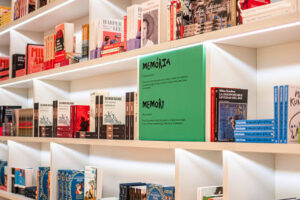
Courtesy: Vogue Adria
Even pop culture has caught on. On 27 June 2026, Dua Lipa opened the Manifesto Library inside Porto’s Livraria Lello bookshop, a permanent home for 100 banned and censored titles. As she put it, reading the world brings people closer, and not everyone is in favour of that.
Below are 20 books that fought for their own existence and won so completely that most of us now read them as required reading rather than resistance literature.
…
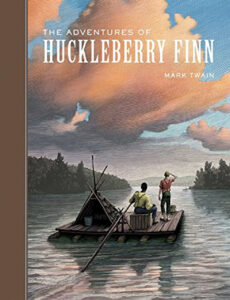
1. The Adventures of Huckleberry Finn by Mark Twain (1885).
Weeks after publication, the Concord Public Library in Massachusetts banned it outright. A committee member called it “trash,” more suited to “the slums than to intelligent, respectable people.” Twain was delighted rather than wounded, telling his editor the ban would “sell us another twenty-five thousand copies for sure.” The controversy certainly gave the novel enormous publicity, and the book has never gone out of print since. Hemingway later said all modern American literature comes from this one book — widely regarded as the first major American novel to let an uneducated, morally serious kid narrate American life in his own voice, dialect and all, instead of a polished adult’s version of it.
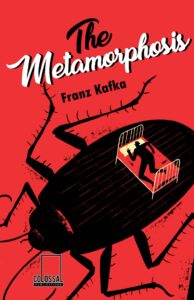
2. The Metamorphosis by Franz Kafka (1915).
The Nazis prohibited Kafka’s works largely because he was Jewish. Soviet authorities also suppressed them for decades, labelling it “decadent” and “despairing.” Kafka himself asked his closest friend, Max Brod, to burn every manuscript he left behind. Brod refused, and that single act of disobedience is a major reason Kafka’s work survived to shape what we now call “Kafkaesque.” The novella’s real horror was never the insect but waking up to find your community has already decided you’re disposable, which is what both regimes wanted kept off the page.
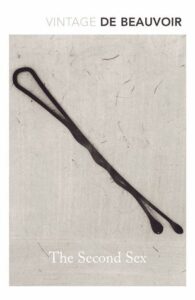
3. The Second Sex by Simone de Beauvoir (1949).
The Vatican placed it on its Index of Forbidden Books in 1956 for dismantling religious and patriarchal ideas about womanhood. Beauvoir wasn’t writing abstract philosophy but was arguing, in plain mainstream print, that femininity is something built and imposed rather than natural or God-given. The shocking imagery along with her indisputable arguments got it banned. It’s since been translated into more than 40 languages and remains widely regarded as a foundational text of second-wave feminism.
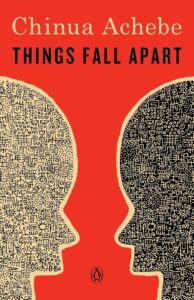
4. Things Fall Apart by Chinua Achebe (1958).
It has faced censorship and removal from schools in Malaysia and has been challenged in Nigeria at different points, while also appearing on a list of works challenged in Texas schools in 2012, despite being widely taught as a foundation of African literature in English. Achebe deliberately wrote it in English, believing he could reshape the coloniser’s language into something capable of carrying Igbo experience, refusing to let Igbo life be narrated only by outsiders who saw it as primitive. Handing the pen back to the people empire had always described, rather than listened to, was the real provocation, more than any single scene in the book. It’s now widely regarded as the most widely read African novel ever written, translated into more than 50 languages and taught on syllabuses across the world.
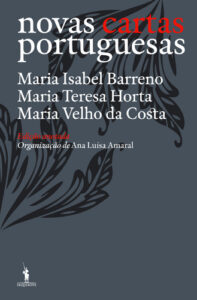
5. New Portuguese Letters (“The Three Marias”) by Maria Isabel Barreno, Maria Teresa Horta, and Maria Velho da Costa (1972).
Banned by Portugal’s fascist Estado Novo regime for its raw depictions of female desire and its anti-colonial politics. All three authors were arrested and tried for obscenity, and the trial turned into an international feminist cause, since prosecuting three women for what they’d written only broadcast how afraid the regime was of it. The trial became one of the regime’s most internationally embarrassing episodes, and the dictatorship fell during the 1974 Carnation Revolution just months later—a rare case of a banned book outliving the government that banned it by mere months.
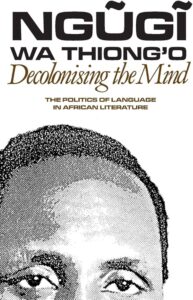
6. Decolonising the Mind by Ngũgĩ wa Thiong’o (1986).
Ngũgĩ wrote this manifesto for African-language literature while already in exile, having been imprisoned without trial in Kenya years earlier over a play performed in Gikuyu, then eventually remaining in exile after continued political persecution and threats. His argument is that language itself is a battlefield, and that colonial languages often carry colonial ways of seeing the world. Written from the hard-won distance of exile rather than safety, it became a foundational text of postcolonial studies worldwide, still assigned wherever people study how empires try to own not just land, but thought.
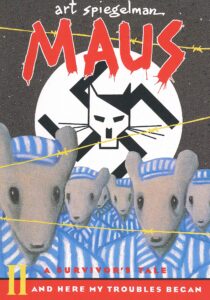
7. Maus by Art Spiegelman (1986).
A Tennessee school board voted to pull it from classrooms in 2022 over “crude language” and nudity, in a Holocaust memoir where the victims are drawn as mice and the perpetrators as cats. That distanced depiction is what lets readers stay with the material, rather than turn away the way they might from photographs of the same events. In 1992 it won a Special Pulitzer Prize, and it remains, according to the Pulitzer’s own records, the only graphic novel ever to receive one, proof that a medium adults associate with children’s entertainment could still carry the full weight of genocide.
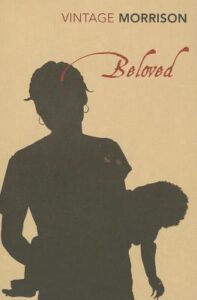
8. Beloved by Toni Morrison (1987).
Inspired by the true story of Margaret Garner, an enslaved woman who killed her own infant daughter rather than let her be returned to slavery, the novel follows a formerly enslaved mother haunted by that same impossible choice. School districts have repeatedly targeted it, most recently Virginia’s Spotsylvania County in 2022, over its stark depiction of slavery’s violence, including sexual violence some parents call too explicit for teenagers. It won the Pulitzer Prize in 1988, and Morrison went on to become the first Black woman to win the Nobel Prize in Literature, in 1993, permanently changing what American literature was allowed to sound like once it finally told this history head-on.
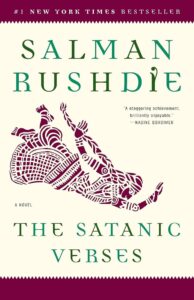
9. The Satanic Verses by Salman Rushdie (1988).
A magical-realist novel that, in one dream sequence, reimagines episodes from early Islamic history in ways many Muslims considered a direct insult to the Prophet Muhammad and his wives. It was banned within weeks in India, Pakistan, and over a dozen other countries, and it prompted Ayatollah Khomeini to issue a fatwa calling for Rushdie’s death, forcing him into hiding under police protection for nearly a decade. His Japanese translator was later killed, and several other translators and publishers were attacked. It remains one of the most significant works of postmodern fiction of the century, and the clearest global symbol of a book that refused to stop existing. India’s ban only ended in November 2024, when the Delhi High Court ruled it invalid after government officials admitted they’d lost the original paperwork that imposed it back in 1988.
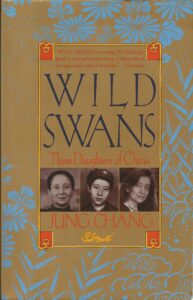
10. Wild Swans by Jung Chang (1991).
Outlawed in mainland China for laying bare the brutal realities of the Cultural Revolution through three generations of women in Chang’s own family. Its real threat to Beijing was that a state-controlled era of history was being narrated by the people who lived through it, rather than the party that ran it. Still blacklisted at home, it’s sold more than 10 million copies worldwide, becoming one of the bestselling memoirs ever published.
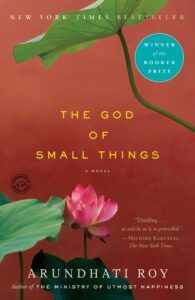
11. The God of Small Things by Arundhati Roy (1997).
Faced obscenity lawsuits in Kerala over a love affair between an upper-caste woman and a Dalit man, a plotline that struck directly at India’s caste taboos and drew formal complaints for supposedly corrupting public morals. Roy held her ground through the court battles rather than soften a line, arguing that a novel about who is and isn’t allowed to be loved was never going to sit comfortably in a society still built around this baseless hierarchy. It won the Booker Prize in 1997, making her the first Indian woman to do so, and has sold millions of copies worldwide.
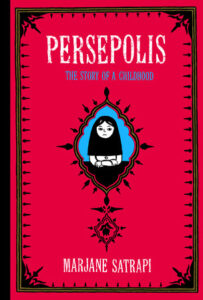
12. Persepolis by Marjane Satrapi (2000).
Banned in Iran for its critique of the regime and religious fundamentalism, and pulled by American school boards, including a widely reported 2013 controversy in Chicago, over a scene depicting torture. Its stark black-and-white art was part of the point: a child’s raw, unadorned view of a revolution turning violent is harder to wave away than an adult’s polished political argument. It became a global bestseller and an Oscar-nominated film, and remains one of the clearest proofs that a banned book can also become a beloved one.
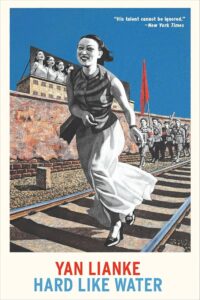
13. Hard Like Water by Yan Lianke (2001).
Suppressed in China as ideologically toxic, for fusing political zealotry with eroticised satire, imagining Cultural Revolution fervour as something close to sexual obsession. Lianke has said openly that he self-censors just to get published in China at all, which makes the books that still get banned there feel like the ones he refused to soften. He won the international Franz Kafka Prize largely on the strength of this novel, a title his own government has never let its citizens openly celebrate, even as it collects his other, safer prizes at home.
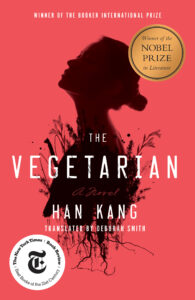
14. The Vegetarian by Han Kang (2007).
Removed from some South Korean school libraries following challenges by conservative groups for its violent rejection of social norms around womanhood and the body, as a woman’s decision to stop eating meat spirals into a total refusal of the role assigned to her. It wasn’t the violence in the book that unsettled the boards who banned it, so much as a woman quietly refusing to stay legible to the people around her. It won the International Booker Prize in 2016, the first Korean-language novel to do so, and turned Han Kang into a genuine global literary figure; she went on to win the Nobel Prize in Literature in 2024.
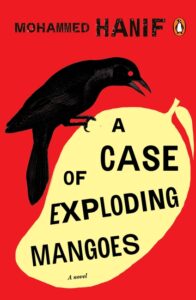
15. A Case of Exploding Mangoes by Mohammed Hanif (2008).
Copies were seized by authorities in Pakistan for satirising General Zia-ul-Haq’s military dictatorship and its still-unresolved plane crash death. Hanif, a former air force fighter pilot himself, knew exactly which details of military life would sting hardest, and wrote the satire with an insider’s precision rather than an outsider’s guesswork. Decades later, that insider’s edge was apparently still sharp enough to rattle the regime’s successors, who seized copies anyway. It won the Commonwealth Writers’ Prize for Best First Book and remains a touchstone of political satire from the region.
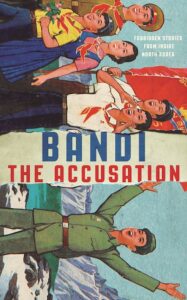
16. The Accusation by Bandi (2014).
Written under a pseudonym inside North Korea, where dissident writing can carry the death penalty. The manuscript was smuggled across the border hidden inside pages of the very propaganda it defied, carried by a courier who still doesn’t know the author’s real identity. Its stories follow ordinary, loyal citizens slowly waking up to the fact that the system they trust is what’s crushing them, which is the one realisation North Korea’s propaganda machine exists to prevent. It stands as the first known work of dissident fiction to escape North Korea while its author remained inside.
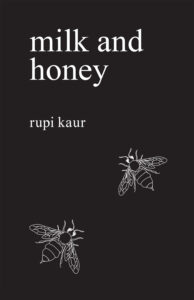
17. Milk and Honey by Rupi Kaur (2014).
Self-published by a 21-year-old university student, it’s since been marketed as the bestselling poetry collection of the 21st century, with more than 6 million copies sold worldwide. It’s also one of the most frequently challenged books in the United States, targeted by Texas and Oregon school districts over its verses on sexual assault and abuse. The same blunt honesty that made it resonate with millions of young readers is what made plenty of adults nervous about handing it to them. Along with its two follow-up collections, Kaur’s work has now sold more than 11 million copies combined.
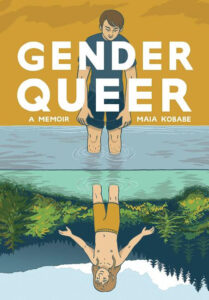
18. Gender Queer by Maia Kobabe (2019).
Topped the American Library Association’s list of most challenged books for several years running, making it the single most targeted title of its era, for its frank, illustrated account of Kobabe’s journey toward a nonbinary identity. The controversy dramatically increased public attention to the book, with many readers seeking it out after attempts were made to remove it from libraries and schools. It’s now regularly cited as the clearest modern case of a ban acting as free advertising.
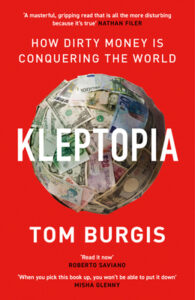
19. Kleptopia by Tom Burgis (2020).
Hit with a costly libel suit from a company examined in its reporting on how dirty money moves through Western institutions, using a tactic known as a SLAPP suit, designed to bankrupt a writer into silence rather than win the argument on the facts. Burgis and his publisher successfully defended the case in London’s High Court, with the judge dismissing the claim and awarding costs against the company. The book is now read as something close to a working guide to how corruption actually moves money, and how it tries to silence the journalists who get too close to it.
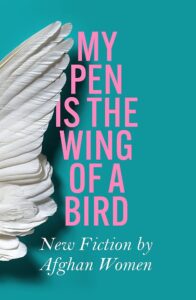
20. My Pen Is the Wing of a Bird by Afghan Women Writers (2022).
Eighteen named writers from inside Afghanistan, developed over two years through Untold Narratives’ Write Afghanistan project, the first major anthology of short fiction by Afghan women writing from inside Afghanistan. The project was already underway when the Taliban retook Kabul in August 2021, and conditions changed overnight: writers’ stories had to be pulled from public view and their identities protected, some were helped to leave the country, and the team kept working together at real risk to finish the book anyway. It arrived as the Taliban began barring women from speaking in public at all, which makes the anthology itself an act of defiance before a single reader opens the cover.
…
Every one of these books was supposed to disappear. Instead, the attempt to erase them is the reason we’re still talking about them, decades or sometimes centuries later. None of that happened by accident. Real people went into hiding, into prison, into exile, and in at least one case, into a grave, to get these words in front of us. Censorship lost, but only after someone paid for it, and there’s no guarantee the next banned book gets that same luck. Next time you pick up a banned book, know that you’re contributing to that fight for free expression.
Book cover images courtesy of Goodreads.
[…] To find out more about banned books that changed the world, a select list from Dua Lipa’s library, click to read this blog. […]
I had an idea that books too get banned and most of the times it’s controversial only…but the extent to which they had gone, many times the reason for which they got banned is unimaginable and wrong. It is a strong proof of the fact that if one tried to supress art (may it be in any form), the results are gonna be the opposite. Before this blog, I did not know that books like ‘Beloved’ and ‘God of Small Things’ also faced bans.
And kudos to you for researching so thoroughly on the books, finding them and bringing them to our eyes. Hats off.