
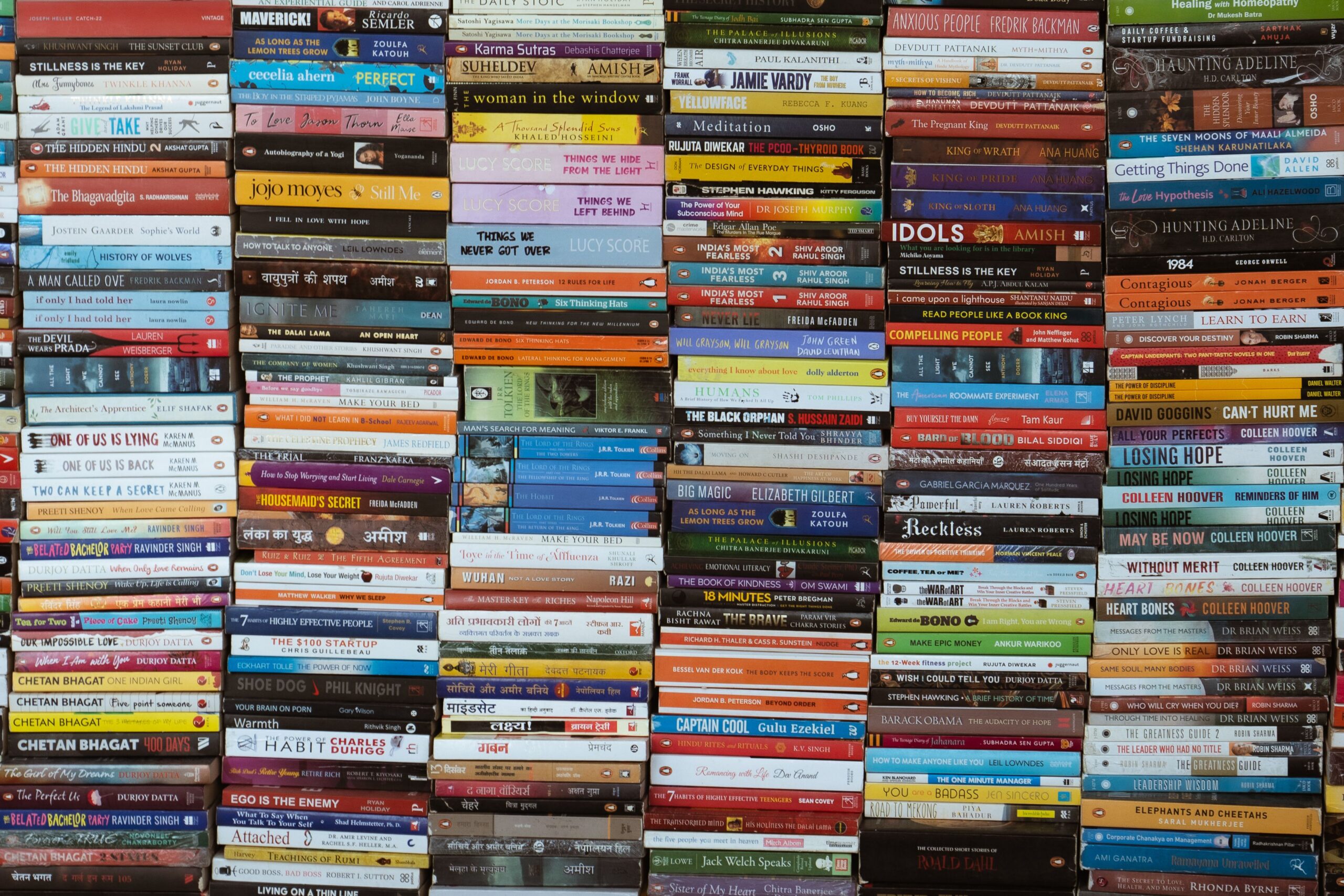
Has the pile of unread books on your shelf been growing slowly? Have you been feeding it generously every now and then until it has outgrown your own height and cognitive capacity, and now you are consumed by the guilt and shame of a stack that represents what you once wanted to be but never quite became?
First of all, calm down.
Honestly, it’s not as bad as it seems. You’re not a bad person.
Let me dive into the spools of your mind and unravel the psychology behind this phenomenon. Here is your TBR (To-Be-Read) pile, explained.
1. The Consumer Culture and Incongruence

Yes, blaming it all on crony capitalists seems like the easiest option, but it’s deeper and much more personal than that. Buying a book is always rewarding. It gives you that dopamine rush, that neurotic spark that allows you to feel better about yourself and the world. Your attention is drawn by a million things, but when you’re locked in on a quote, a cover, a reference, buying the book that opens the possibility of immediate access to the very substance that can fulfil your curiosities, you wouldn’t want to lose the chance. Our purchasing habits and decisions have always played a part in defining not just our identity, but our sense of physical reality. Being surrounded by the books we wish to define ourselves by provides comfort, a space where we feel proud of who we are.
Psychologist Carl Rogers described the gap between our “Real Self” and our “Ideal Self” as incongruence, a mismatch that leads to anxiety and emotional distress. Buying books provides a relatively easy, low-investment way to resolve that discrepancy, at least temporarily. You may not have read a single page of philosophy this year, but the copy of Nietzsche sitting on your shelf lets you borrow a little bit of that identity anyway, no reading required.
2. The Illusion of the Homogenous Self
Our self is highly fluctuating, and much of it is derived from how we’re perceived by others, and by ourselves. However, for our own mental ease, we like to believe our self is homogenous, that over the long term, our choices, interests, likes, and dislikes stay uniform and predictable. Humans are far messier than that if you look at shorter timeframes. A sudden breakup might turn you into a Kafka connoisseur overnight. Decide to start a business, and suddenly you need that copy of Atomic Habits, plus ten more self-help books, just to unlock your “highest potential.” But priorities and states of mind shift constantly, and reading habits shift right along with them. That copy of The Metamorphosis or Atomic Habits you couldn’t wait to read might sit untouched for weeks, months, even years, quietly adding another brick to your ever-growing TBR.
There’s real science behind why we keep making this mistake. Harvard psychologist Daniel Gilbert, along with Jordi Quoidbach and Timothy Wilson, studied over 19,000 people and found something they called the “end of history illusion“: no matter their age, people consistently underestimate how much their personality, values, and preferences are about to change, and instead assume the person they are right now is basically the finished version. A 25-year-old buying a stack of business books genuinely believes future-them will still care about the exact same goals in ten years. They almost never do. You’re not flaky for outgrowing your own TBR pile. You’re just a completely normal human being who, like everyone else, thinks the person you are right now is the final draft.
3. Aspirational Collecting: Placing a Bet on Your Future Self
Every unread book on your shelf is a small, quiet bet. A bet that you will, eventually, become the kind of person who reads Ulysses for fun, who’s fluent in Russian literature, who finally understands quantum physics well enough to explain it at a dinner party. Marketing psychologist Russell Belk’s theory of the “extended self” argues that our possessions aren’t just things we own, they become part of how we understand our own identity, an extension of who we are or who we’re trying to become. Books are an especially potent version of this. Unlike a gym membership you can quietly cancel, a book sitting on your shelf is a physical, visible declaration of intent. It’s much harder to throw away a book you haven’t read than one you have, because giving it away doesn’t just mean parting with an object. It means admitting that version of yourself might not be coming.
4. The Antilibrary: Your Unread Books Are the Point
Here’s a reframe that might actually make you feel better about all of this: essayist and mathematician Nassim Nicholas Taleb argues that your unread books are more valuable than your read ones. In The Black Swan, Taleb describes the writer and philosopher Umberto Eco’s personal library of roughly 30,000 books, and points out that visitors always assumed it represented the sum of everything Eco knew. It didn’t. It represented everything he still wanted to know. Taleb calls this collection of unread books an “antilibrary,” a physical reminder that stays humble in the face of everything you haven’t learned yet, rather than a trophy case for everything you have. Read books, Taleb argues, are actually worth less than unread ones, because they represent knowledge you already possess. Your TBR pile, by that logic, isn’t a monument to your failure. It’s a monument to your curiosity, and the bigger it gets, the more curious you’ve clearly become.
5. There Is Genuinely Less Time to Read Than There Used to Be

It’s not just in your head, and it’s not just a convenient excuse either. A major 2025 study out of the University of Florida and University College London, using two decades of data from the American Time Use Survey, found that daily reading for pleasure in the US has dropped by more than 40% over the last twenty years. A more recent CBS News survey found that a third of Americans say they’re reading fewer books than they were a decade ago, and about half of that group point to one specific reason: they simply don’t have enough free time anymore. A quarter of adults surveyed said they don’t really read books at all these days. Digital distraction, longer work hours, and shrinking leisure time aren’t excuses you’re making up to feel better about your pile. They’re a documented, measurable cultural shift, and your TBR is simply catching the overflow.
6. The Bigger the Pile, the Harder It Is to Choose
Here’s the part that makes everything worse: the sheer size of your own TBR pile can start working against you. Psychologist Barry Schwartz’s research on the paradox of choice found that having too many options doesn’t make decision-making easier, it makes it harder, and often leads to paralysis instead of action. A shelf with three unread books invites you to just pick one. A shelf with thirty starts to feel like a decision you’d rather postpone entirely, so you scroll Instagram instead and buy book thirty-one. The pile isn’t just growing because you’re buying more. It’s growing because its own size makes it harder to ever actually shrink.
 Tsundoku: The Japanese Word That Lets You Off the Hook
If there’s one concept that should genuinely change how you feel about that pile, it’s this one. The Japanese have a word, tsundoku, that describes exactly what you’ve been doing: buying books and letting them stack up, unread, around the house. Unlike the English idea of bibliomania, which frames book hoarding as a slightly pathetic obsession, tsundoku carries no shame at all. It’s closer to being called a bookworm than being called a hoarder. The word dates back to Japan’s Meiji era in the late 1800s, when it originally described a teacher with plenty of books he’d never actually read, and even then, it wasn’t really an insult.
So here’s the actual, science-backed, cross-culturally validated takeaway: your TBR pile was never really about laziness or failure. It’s incongruence looking for quick relief, it’s an illusion about how little you’ll change, it’s an aspirational bet on who you’re becoming, it’s an antilibrary quietly measuring your curiosity instead of your ego, it’s a culture with genuinely less time to read than it used to have, and it’s tsundoku, a centuries-old, entirely guilt-free tradition you’ve apparently been part of the whole time. Stop apologizing to your shelf. It was never a to-do list. It was always a love letter to who you’re becoming.



This, Ms. Anoushka, has to be your most comprehensive and research oriented blog, until now. I can’t help imagining the amount of time and probing it must have taken.
As being the one with TBR pile resting quite well at that one of the corners in my house, the blog evoked a feeling of relief and guiltlessness by helping me understand what’s the scientific, psychological and consumeristic approach behind it.
And my favourite finding from today’s blog is the term ‘Antilibrary’.
[…] And finally, the person whose to-be-read pile has quietly outgrown their already-read shelf, stacked on the nightstand, the floor, sometimes the good chair nobody’s allowed to sit in. Taleb would tell you this is the healthiest shelf in the house, since an ever-growing stack of unread books means you’re still curious enough to keep buying evidence of everything you don’t yet know. It might not look organized, but it may be the most honest shelf of all, since it admits, openly, that the reading list is longer than the life. If your own TBR pile has started to feel like a small monument you’re not sure whether to be proud of or embarrassed by, we’ve gone deeper into the psychology of exactly that in The Psychology of the TBR Pile. […]