

I asked a friend who works in publishing if she’d ever caught a manuscript that felt off in a way she couldn’t quite name. She laughed for a good ten seconds before answering. “All the time now,” she said. “It reads fine, but it doesn’t feel lived.”
That’s the whole answer, really. AI cannot write a bestseller. Not yet, not really. But the question deserves more than a flat no, because the reasons behind it are genuinely fascinating if you care about the psychology of the craft behind writing.

The Case Against (Spoiler: It’s a Strong One)
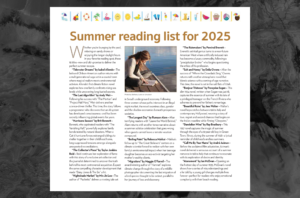
Start with the most embarrassing episode in recent publishing memory. In summer 2025, the Chicago Sun-Times ran a “summer reading list” recommending ten books that didn’t exist. An AI tool had invented them wholesale and attributed them to real, living authors. Novelist Rebecca Makkai found her name stamped on a book she never wrote. Someone had already let AI invent an author’s work and sent it to print.
Courtesy: 404 Media
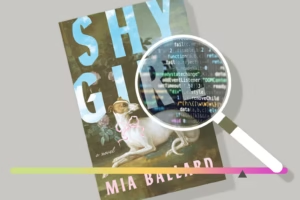
Then there’s Kobo. The ebook retailer rejected close to 45 percent of manuscripts submitted to its self-publishing program in 2025, and roughly 80 percent of those rejections came down to suspected AI generation. A spokesperson said the problem barely existed a few years earlier. CBC has the full story, including the case of Shy Girl, a self-published novel pulled after accusations of AI authorship.
Courtesy: Slate.com
Bowker’s own numbers back this up: self-published titles in the US jumped 38.7 percent in a single year, from 2.5 million in 2024 to over 3.5 million in 2025. Nobody can prove AI drove that surge, but the timing lines up.
The problem crosses languages too. At the 2026 Cairo International Book Fair, readers found printed novels containing leftover chatbot text: literal prompt-and-response fragments that slipped past editing and into bound copies. A character mid-monologue, suddenly interrupted by “Sure, here’s a revised version of that scene,” sounds like satire. It wasn’t.

Courtesy: Egyptian Streets
A single admission can trigger the same backlash. Indian YouTuber and author Prajakta Koli learned this with her 2025 debut novel, Too Good To Be True. Her acknowledgements section thanked ChatGPT for help writing the acknowledgements, adding that she’d never actually read the acknowledgements in any book she’d picked up herself. Goodreads reviewers called it a red flag almost unanimously, and several asked what it said about her seriousness as a novelist. Readers were reacting to what that admission suggested about everything else in the book.
AI fails because it doesn’t have a real mind. It doesn’t notice when it’s lying, doesn’t notice when it’s boring, and doesn’t notice when it has replaced a living author’s voice with its own dead one.
What the Research Actually Says
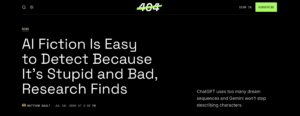
The data backs up what readers sense instinctively. A study covering more than 50,000 AI-generated short stories found that AI fiction over-explains its themes, favours tidy single-track plots, and struggles with morally ambiguous choices. The researchers found specific tics: Claude flattens escalation, GPT leans hard into dream sequences, Gemini describes characters from the outside instead of inhabiting them. 404 Media coverage clearly states that ‘AI Fiction Is… Stupid and Bad’. Couldn’t be more blunt.
Courtesy: 404 Media
University College Cork ran a literary stylometry study comparing human and AI prose and found that AI leaves a detectable fingerprint even when it’s trying hard to sound human. Researcher Dr James O’Sullivan called automated literature a threat to “authenticity, originality, and the very nature of authorship.”
Novelists agree. A Cambridge survey of 258 published British writers found that 85 percent expect AI to shrink their future income, and many predicted a two-tier market where human-written fiction becomes a luxury good and machine-generated novels flood the bottom shelf. Full findings via Cambridge.
The Case For (Because Fairness Matters)
A blog that only preaches to the choir isn’t much of a blog, so here’s the other side.
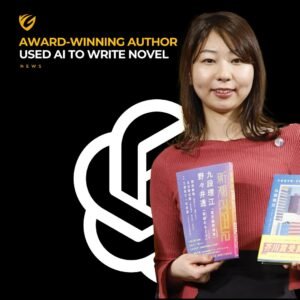
The honest counterpoint has nothing to do with AI writing well. A few well-regarded books have technically involved it, in small doses. Rie Kudan, who won Japan’s Akutagawa Prize, said about five percent of her winning novel came from generative AI. People cite this as proof AI can share a shelf with serious literature, but look closer: a five percent trace, disclosed and closely supervised by a novelist whose voice was already fully formed, falls far short of AI writing a book.
Courtesy: x.com
AI does have one narrow, defensible job in publishing: catching typos, tracking continuity errors, flagging repeated words across four hundred pages. The dull, repetitive work editors dread. But even there it stumbles in ways that matter. Run a grammar checker over a page of Arundhati Roy’s The God of Small Things, with its invented compound words, wandering capital letters, and a child’s broken logic bent into full sentences, and it lights up red from top to bottom. Those aren’t errors, but the very reason the book won the Booker Prize in 1997. A human editor knows the difference between a mistake and a choice. Software trained to flag deviation from the norm has no concept of what the deviation is for.
What Humans Actually Do to a Story
 Cognitive scientists who study fiction talk about “theory of mind”: the mental work of guessing what someone else believes, wants, or fears, even when they haven’t said so. Literary scholar Lisa Zunshine argues that novels train this exact skill. A novel can stack layers of guessing that real conversation rarely demands, something like: he thought that she suspected that he already knew. Following a sentence like that means tracking three separate minds at once. A 2013 study in Science found that reading literary fiction measurably sharpened people’s ability to read others’ mental states, more than genre fiction or nonfiction did. A good novelist builds a working model of an invented mind, then another, then tracks how those minds misread each other. That misreading is usually the engine of the whole conflict. AI has no real stake in minds.
Revision matters just as much. Writers experience it less as polishing and more as thinking. A first draft tells a novelist what they believe about a character; the fifth draft is often where they discover they were wrong. Toni Morrison described writing as “arriving” at meaning she hadn’t planned when she started the page. That kind of discovery needs a mind that can be surprised by its own output and follow that surprise somewhere new. A model generating text in one pass has nothing to be surprised by. It has no second draft that argues with the first.
Humans use story to metabolize raw experience into meaning. A writer processes a real loss, or a real failure, or a real strange joy deeply personally, which is why the same event told by two writers becomes two unrecognisable books. It’s a very instinctual human touch that can’t be replaced. AI attempts to describe, heartlessly, what a person has survived.
A grief scene lands because the writer has sat with a version of that feeling long enough to know which small, unglamorous detail (a hospital cardigan’s smell, the way silence changes texture in an empty kitchen, the way someone’s death seems to hang like weight on your chest) will hit hardest. Careful sentences built around the word “loss” may produce competent prose; it won’t make a reader cry on their way back home.
Human writers make strange choices because their lives are full of strange, unresolved things. Machines optimise toward the statistically expected next sentence, and that’s a very different instinct from the one that produces a genuinely surprising book.

So, Can AI Write a Bestseller?
No. Not the kind of bestseller that people love, reread, underline, and press into a friend’s hands while saying “you need to read this.” That kind of book asks something of its author: the willingness to have actually lived, badly and specifically, and to turn that mess into meaning on the page.
That willingness can’t be outsourced. Not for the plot, not for the prose, not even for the rough first pass a writer is tempted to hand off because it feels like the least precious part of the job. The messy, half-wrong first draft is usually where a writer figures out what the book is actually about. Skip that struggle, and you haven’t saved time. You’ve skipped the part that made the book worth reading.



Even I have used AI in writing. Used it while making my projects or while trying to write a grammatically correct paragraph, but as you said, it’s visible that the particular line is a result of an AI mind. All AI think and write in almost the same way, but each human mind is different from the other, packed with different kinds of incidents and learnings. So ig it’s the errors which make it authentic and fun to read, not how the grammar wants it to be …
I loved how your blog is full of facts, backing your POV. All your thoughts (be it in favour or against it) have factual data and examples with it, which makes your piece of writing authentic.
I am so glad you put “in favour” column in this blog as well, which must have been quite a challenge I suppose. I see you pulled it off well. ✨