
The em dash is 500 years old. Older than your grandmother’s grandmother’s punctuation opinions. So the next time you see a piece of prose riddled with this slightly elongated dash, resist the urge to cry “AI!” It may just be a sign of literacy and the art of punctuation—not AI slop.
Courtesy: The Globe and Media
The Use
The em dash is one of the most versatile punctuation marks out there, and unfortunately, it has earned itself a bad name because ChatGPT and its cousins have made it their holy grail. The em dash gets its name from traditional typesetting, where its width was roughly that of the capital letter ‘M.’ It mainly serves three functions:
- To create a pause or introduce a parenthetical element that needs more emphasis than a comma, but less formality than parentheses e.g. The monkey—who was in love with bananas—sulked at the thought of an apple.
- To emphasize or isolate a point e.g. She had only one thing on her mind—to make her wedding day scandalous.
- To signal an abrupt change in thought e.g. I was planning to hit the gym—wait, did I leave the stove on?
You can also use it to replace a colon, or even censor an oath word, but that’s a whole different discussion—or so I be d—d.
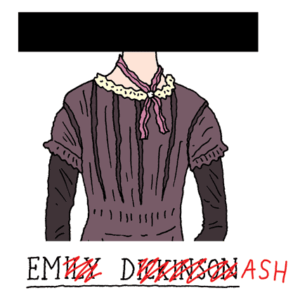
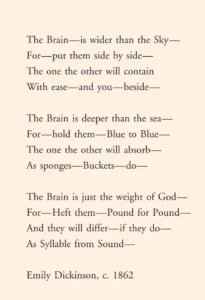
The em dash predates AI by centuries, and plenty of authors have been infamous for their profuse use of it. Be it Emily Dickinson—who used it so obsessively her manuscripts look like they were attacked by a horizontal line—Mark Twain, or F. Scott Fitzgerald, the em dash has always had a following of the literary elite.
Did they have ChatGPT? I guess not.
Courtesy: New York Times Web Archive
Emily Dickinson gets a special mention here, because there’s a rumour flying around that the em dash was named after Emily herself. That’s just false—delightfully false, but false—even though her use of dashes, in all shapes and sizes, makes her the Nobel Laureate personification of the em dash’s personality. As one commentator notes, “Dashes [in her work] are either long or short; sometimes vertical, as if to indicate musical phrasing, and often elongated periods, as if to indicate a slightly different kind of pause… Dickinson uses dashes musically, but also to create a sense of the indefinite, a different kind of pause, an interruption of thought, to set off a list, as a semi-colon, as parentheses, or to link two thoughts together…” Basically, she did in the 1860s what your group chat does today with ellipses and vibes.
‘The Brain’ by Emily Dickinson
The History
A stroke or horizontal line occurring in a sentence naturally makes the human mind pause and pay attention. Thus, the em dash has quite a history behind it. The Ancient Greeks used horizontal marks to indicate pauses or divisions within a sentence. Such strokes have also turned up in medieval manuscripts, signalling breaks in thought long before standardised punctuation systems existed—so somewhere, a monk with an ink-stained sleeve was doing this before it was cool.
After the printing revolution in the 15th century, early printers created dashes by jamming multiple hyphens together. Then came the typewriter, which did away with the dash entirely to save space, so a double hyphen (–) was accepted as its stand-in. This was later formalized by modern automation, so when your laptop keyboard converts two hyphens into a long, sleek em dash, take a second to be reminded of the long, slightly chaotic history behind that tiny, satisfying autocorrect moment.
Quick aside: don’t confuse the em dash with its smaller cousin, the en dash, sized after the capital ‘N’ and used only to connect ranges—pages 12–44, the years 1941–1945, the New York–London flight. It’s the reliable sibling who does the taxes. The em dash is the one who shows up to family dinner two hours late with a story, which is exactly why it’s the one we’re here to talk about.
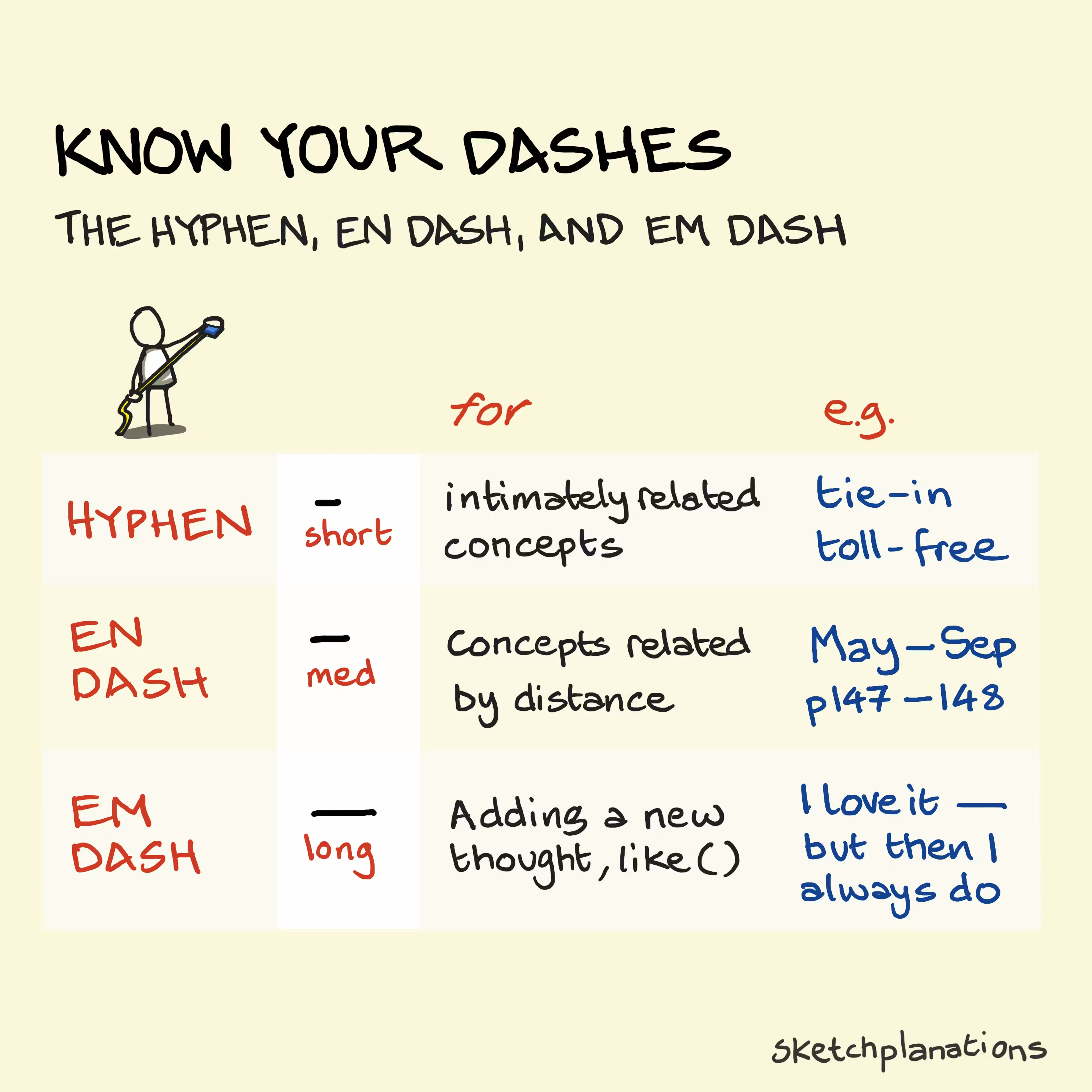
Courtesy: Sketch Plantations
The Personality of the Em Dash
I like to call the em dash the Lord Byron of punctuation marks, because of how multifaceted yet misunderstood it is. Byron was famously labelled by Lady Caroline Lamb as “mad, bad, and dangerous to know,” reducing his complex legacy to a simple caricature of a scandalous rake—and that’s exactly what we’ve done to the innocent ‘mad’ dash. One era’s literary genius is another era’s punchline, and the em dash, like Byron, deserves better press.
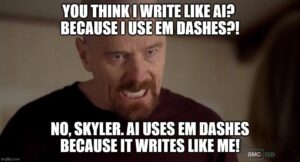
Courtesy: The Wandering Shop
In a New York Times piece, Prof. Ben Yagoda gives examples of the difference an em dash can make—breathing life and energy into sentences that would otherwise just sit passively on the page, doing absolutely nothing for anyone.
Scott Fitzgerald, The Great Gatsby:
Thirty: the promise of a decade of loneliness, a thinning list of single men to know, a thinning briefcase of enthusiasm, thinning hair.
Thirty—the promise of a decade of loneliness, a thinning list of single men to know, a thinning briefcase of enthusiasm, thinning hair.
Henry James, on Henry David Thoreau (from his 1879 biography of Hawthorne):
He was worse than a provincial, he was parochial.
He was worse than a provincial—he was parochial.
Mark Twain, from Pudd’nhead Wilson’s New Calendar, the epigraph series that ran through Following the Equator:
…life does not consist mainly (or even largely) of facts and happenings. It consists mainly of the storm of thoughts that is forever blowing through one’s head.
…life does not consist mainly—or even largely—of facts and happenings. It consists mainly of the storm of thoughts that is forever blowing through one’s head.
Twain, same Calendar:
Each person is born to one possession which outvalues all his others: his last breath.
Each person is born to one possession which outvalues all his others—his last breath.
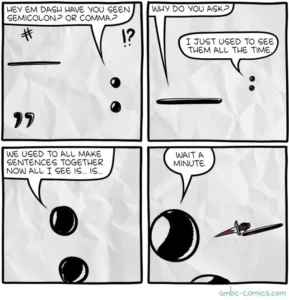
Courtesy: SMBC Comics
Read each pair out loud and you’ll feel it: the colon informs, the comma politely suggests, but the dash lands. If being grammatically correct were the only goal of a writer, the em dash would never have been used at all. But grammar is the least of one’s concerns when you’re writing things that will be called masterpieces a century from now. Yagoda puts it well: “Like hitting the right combination of buttons in a computer game, typing two hyphens on the keyboard—and thereby making a dash—can give your prose a burst of energy, as if by magic.”
Innocent Until Proven AI
Why do AI algorithms use the em dash so much?
Well, the answer is simple. AI has been trained on thousands of well-written pieces—novels, prose, journals, research, articles—considered the best of the best, most of which use the em dash liberally. The AI learned proper punctuation from proper writers, which says a lot more about the writers than it does about the AI. It also leans on the em dash because its training data is stuffed with marketing copy, which uses dashes to manufacture artificial excitement out of very ordinary products. But AI reaches for it as a lazy crutch to avoid building a real sentence, whereas human writers use it deliberately, to shape tone and tension and the occasional dramatic pause.
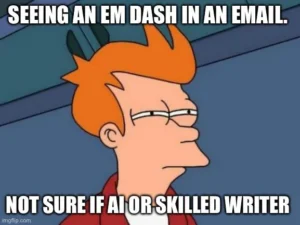
You can tell the difference between genuine human use of an em dash and AI’s version with a simple gut check. Human text has a pulse. Something strikes you that doesn’t in AI content—your brain catches patterns of rhythm, intent, repetition, the sense that a person paused there on purpose. AI, on the other hand, leans on repetitive, formulaic structures, often deploying a signature triple-dash pattern:
[Noun/Concept]—[Generic Definition]—[Supposed Benefit]
AI example: “Our new software—designed by industry experts—streamlines your daily workflow effortlessly.”
Notice how it does absolutely nothing except sound vaguely impressive. Humans use the em dash the opposite way: to mimic the messy reality of actual speech and thought, the way we interrupt ourselves, backtrack, and change our minds mid-sentence.
The pattern is the tell, not the punctuation mark itself. So next time you spot a manuscript full of em dashes, don’t jump to “this was written by a robot.” It may just be a frantic, punctuation-loving writer trying to capture how a mind actually moves. And if you’re a writer, the next time you are feel forced to replace an em dash out of fear that someone might question your authorial integrity, just share this blog with them—rest assured, I’ve got you and your em dashes covered.
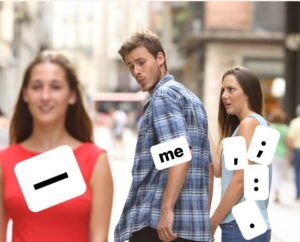
Courtesy: Buzzfeed
Byron didn’t tone himself down for the critics, and neither should your dash. Count yours with pride, like I counted mine. This blog consists of 32 em dashes.
Whether you love ’em or not, they’re here to stay ;)
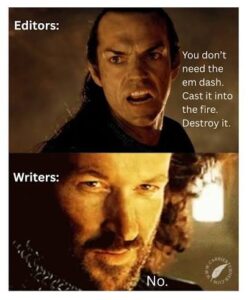



Never knew using em dash could attract controversy. But now it would not as we have this blog to defend us.
Grammar has a specific use of every size of dash not everybody is aware of. These kind of artcles should be written more for the layman.
Thanks for this well-researched, self-explanatory, informative article!!
Oh this blog…first of all, I had no idea it’s called ‘Em dash’, I thought it’s called just “dash”. Uk first of all— I absolutely loved how you used them throughout your blog which worked excellently as practical examples, and other than that— how you used memes in this blog was so creative and fun to read (girl you deserve a raise 🫵🏼).
This blog and you made me use the ’em dash’ for the first time in my life. I didn’t know it’s different from hyphen.
Wow, a punctuation mark crossed ages and centuries and still is so relevant that it’s said to be a mark of an AI text.
From today’s blog, I found out about three types of dashes, the Hyphen, en dash and em dash, and I feel so smart after reading it—like I have some kind of a degree in English literature.